1st Reading – 2 Kings 4:42-44
A man came from Baal-shalishah bringing to Elisha, the man of God,
twenty barley loaves made from the firstfruits,
and fresh grain in the ear.
Elisha said, “Give it to the people to eat.”
But his servant objected,
“How can I set this before a hundred people?”
Elisha insisted, “Give it to the people to eat.”
“For thus says the LORD,
‘They shall eat and there shall be some left over.’”
And when they had eaten, there was some left over,
as the LORD had said.
Today’s first reading took place around 850 BC, a tumultuous time in the history of Israel marked by political instability and religious strife.
The prophet Elisha, the successor of Elijah, emerged as a key figure during this period, performing miracles and providing spiritual leadership to the people of the northern kingdom.
A man came from Baal-shalishah
The unnamed man comes from a place named for Baal, the Canaanite god of fertility. While the exact location of Baal-shalishah is uncertain, its name reflects the Canaanite cultural influence in the region.
During the time of Elisha, Israel was struggling with the sin of idolatry. Worship of Baal was rampant.
bringing to Elisha, the man of God, twenty barley loaves made from the firstfruits, and fresh grain in the ear.
The firstfruits were the best and freshest portion of the harvest and were normally offered to God as an acknowledgment of their reliance on him for provision and a token of gratitude for the entire harvest (Leviticus 23:17-18).
Before the establishment of a formalized priesthood, worshipers would bring their offerings directly to a prophet; that seems to be what is happening here.
Elisha said, “Give it to the people to eat.”
Because food was scarce, Elisha instructs that the offering be given to the people.
This directive is remarkable because it violates cultic regulations. Once an offering was made at the shrine, it belonged to God and was only to be consumed by the prophet. This kind of deviation from protocol was only warranted in extreme circumstances (e.g., 1 Samuel 21:5-6).
But his servant objected, “How can I set this before a hundred people?”
In ancient Israel, bread was typically made in small, flat cakes or round rolls, not the large loaves we are accustomed to today. Each person typically consumed one loaf per meal; twenty loaves would be insufficient for a hundred men.
“Give it to the people to eat,” Elisha insisted. “For thus says the LORD, ‘They shall eat and there shall be some left over.’”
Elisha gives assurance to the servant, expressing confidence in the word and power of God.
It’s unclear exactly what the statement from God refers to, as it does not appear to be a quote from scripture or a reference to a previous event. It is widely understood as a divine oracle received by Elisha in the moment.
And when they had eaten, there was some left over, as the LORD had said.
The miracle occurs exactly as Elisha predicted, validating Elisha’s role as a true prophet and showcasing God’s power and faithfulness.
It also serves as a stark demonstration that the LORD, the God of Israel, not Baal, has sovereignty over all aspects of life.
2nd Reading – Ephesians 4:1-6
Brothers and sisters:
I, a prisoner for the Lord,
urge you to live in a manner worthy of the call you have received,
with all humility and gentleness, with patience,
bearing with one another through love,
striving to preserve the unity of the spirit through the bond of peace:
one body and one Spirit,
as you were also called to the one hope of your call;
one Lord, one faith, one baptism;
one God and Father of all,
who is over all and through all and in all.
Today’s second reading is a call by Saint Paul for unity within the Church.
Brothers and sisters: I, a prisoner for the Lord,
Paul wrote this letter to the Ephesians while being held prisoner in Rome. It is one of his Captivity Epistles, along with Philippians, Colossians, and Philemon.
urge you to live in a manner worthy of the call you have received,
He calls the Ephesians to live in a manner that reflects their divine calling as followers of Christ. Knowing that he makes this exhortation from a prison cell gives weight to his message.
It’s ironic that he is urging them to lead the kind of life that has resulted in his own imprisonment. However, he insists that only such a life is worthy of the call they have received from God.
The Greek verb translated as “live” is peripateō, which means to walk on a certain path, a prominent theme from the wisdom tradition (Proverbs 4:11, Mark 1:3). It suggests that a righteous life is more than conformity to a collection of regulations; it is a commitment to set oneself on a particular path and to hold fast to that path even in the face of difficulty.
with all humility and gentleness, with patience,
Paul provides a list of social virtues that characterize the standards of Christian life, all of which foster harmony within the community:
- Humility is lowly-mindedness, a resistance to seeking prominence over others; it is the opposite of pride.
- Gentleness, or meekness, is an unwillingness to provoke others or to be easily provoked.
- Patience provides the ability to endure difficult circumstances or provocations without getting angry or upset.
bearing with one another through love,
This attitude of forbearance is motivated by love (agapē) — the selfless, sacrificial, unconditional love that is the cornerstone of Christian relationships.
Agapē is the highest of the four types of love referenced in scripture, with the other three being philía, storgé, and érōs.
striving to preserve the unity of the spirit through the bond of peace:
The Holy Spirit creates unity among believers, which they are called to preserve. Peace is the binding force that holds the community together.
Paul stresses the importance of maintaining this unity by listing seven elements that bind Christians to God and each other:
one body
1) Christians are bound to God and each other by belonging to one external visible community: the Church.
“What is this one body? They are the faithful throughout the world – in the present, in the past and in the future. … The body does exist apart from its enlivening spirit, else it would not be a body. It is a common human metaphor to say of things that are united and have coherence that they are one body. So we too take the term ‘body’ as an expression of unity” [Saint John Chrysostom (392-397 AD), Homilies On The Epistle To The Ephesians, 10,4,4].
and one Spirit,
2) Christians are bound to God and each other by the indwelling of the Holy Spirit, who empowers all believers.
as you were also called to the one hope of your call;
3) Christians are bound to God and each other by the shared future expectation of eternal life and the fulfillment of God’s promises.
one Lord, one faith, one baptism;
Christians are bound to God and each other by 4) serving and worshiping the same Lord, Jesus Christ, 5) committing to one shared faith, and 6) celebrating one common rite of baptism.
“The Lord is one and God is one, because the dominion of the Father and of the Son is one divinity. Moreover the faith too is said to be one, because we believe likewise in Father and in Son and in Holy Spirit. And there is one Baptism, for it is in one and the same way that we are baptized in the Father and in the Son and in the Holy Spirit [Saint Jerome (436 AD), Commentaries On The Epistle To The Ephesians, 2,4,5,6-7].
one God and Father of all,
7) Christians are bound to God and each other by their shared monotheistic belief in one God who is the Father of all believers.
who is over all and through all and in all.
Not only is God our sovereign Father, who bonds us together as brothers and sisters, he is transcendent (“over all”), immanent (“in all”) and actively at work in all creation (“through all”).
This passage is a timeless reminder of the importance of living a life that reflects the high calling of being a follower of Christ and the crucial role of unity in the Christian community.
At the time it was written, Paul was referring to the gift of unity between Jews and Gentiles. When we read these words today, it reminds us of our call to unity not only within the Church but among all Christian faiths.
We are called to live so that the unity of Christ’s body is visible to the entire world.
Gospel – John 6:1-15
Jesus went across the Sea of Galilee.
A large crowd followed him,
because they saw the signs he was performing on the sick.
Jesus went up on the mountain,
and there he sat down with his disciples.
The Jewish feast of Passover was near.
When Jesus raised his eyes
and saw that a large crowd was coming to him,
he said to Philip,
“Where can we buy enough food for them to eat?”
He said this to test him,
because he himself knew what he was going to do.
Philip answered him,
“Two hundred days’ wages worth of food would not be enough
for each of them to have a little.’”
One of his disciples,
Andrew, the brother of Simon Peter, said to him,
“There is a boy here who has five barley loaves and two fish;
but what good are these for so many?”
Jesus said, “Have the people recline.”
Now there was a great deal of grass in that place.
So the men reclined, about five thousand in number.
Then Jesus took the loaves, gave thanks,
and distributed them to those who were reclining,
and also as much of the fish as they wanted.
When they had had their fill, he said to his disciples,
“Gather the fragments left over,
so that nothing will be wasted.”
So they collected them,
and filled twelve wicker baskets with fragments
from the five barley loaves
that had been more than they could eat.
When the people saw the sign he had done, they said,
“This is truly the Prophet, the one who is to come into the world.”
Since Jesus knew that they were going to come and carry him off
to make him king,
he withdrew again to the mountain alone.
This week we begin a five-week study of Chapter 6 of John’s gospel.
The Gospel of John is a rich and theologically profound narrative that complements the synoptic Gospels, offering deeper insights into Jesus’ identity and mission. In particular, John Chapter 6, which includes the Bread of Life discourse, provides a pivotal understanding of the Eucharist, a central mystery of our faith. As we delve into these passages, we are invited to reflect more deeply on the nature of Jesus as the Bread of Life, who nourishes and sustains us.
Today’s reading recounts Jesus’ feeding of the five thousand. This story appears in all four gospels, but the details differ from gospel to gospel because each author emphasizes what he wants his particular audience to understand. John’s gospel, written toward the end of the 1st century AD, addresses a community that had begun to outlive the expected timeline for the Second Coming. As such, these believers were in the process of reshaping their expectations and understanding the present reality of eternal life.
Jesus went across the Sea of Galilee. A large crowd followed him, because they saw the signs he was performing on the sick.
The crowd follows Jesus from place to place, compelled by the miracles he has performed. They didn’t necessarily follow him out of faith or to hear his teaching; some followed out of curiosity and hoped they might witness some kind of marvel.
Notice that, unlike the other gospel writers, John refers to Jesus’ miracles as “signs.” This emphasizes that these miracles are not merely acts of power but significant events that reveal the nature of Jesus as the Messiah, inviting believers to see and understand the profound truths about God’s kingdom and salvation.
Many people in the crowds saw the signs but did not understand the identity that the signs pointed to. Faith that is based merely on miracles — without recognizing the nature of the one performing them — would be unstable and transitory; that is, not faith at all.
Jesus went up on the mountain, and there he sat down with his disciples.
Mountains often symbolize a place of teaching and revelation in biblical narratives. Sitting down indicates that Jesus is preparing to teach or address the people, a posture often taken by rabbis.
The Jewish feast of Passover was near.
This is the second of three Passovers mentioned in the Gospel of John. The first is John 2:13-23, the cleansing of the temple early in Jesus’ ministry. The second is this one, the miraculous multiplication of the loaves. The third Passover occurs during the time of Jesus’ passion (John 11:55).
This chronological marker places the events of today’s reading around the midpoint of Jesus’ public ministry, approximately one year before his passion, death, and resurrection.
When Jesus raised his eyes and saw that a large crowd was coming to him, he said to Philip, “Where can we buy enough food for them to eat?”
Jesus’ question introduces the problem of feeding the large crowd and sets the stage for the miracle. Philip, who is from the nearby town of Bethsaida, would logically be consulted about local resources.
Note that there is no mention of the people being hungry or requesting food. Unlike most of his miracles, Jesus is not responding to an explicit need.
He said this to test him, because he himself knew what he was going to do.
John’s gospel often portrays Jesus as all-knowing, emphasizing his divinity.
Philip answered him, “Two hundred days’ wages worth of food would not be enough for each of them to have a little.”
Philip calculates the cost and concludes that feeding the crowd is financially unfeasible, emphasizing the enormity of the need.
Philip had been a disciple of Jesus from the very beginning (John 1:43-44) and had seen all his miracles, including his turning water into wine at the wedding in Cana. It might then be expected that Philip would say something like, “Lord, if you will it, it would be easy for you to feed them all.” Yet Philip takes Jesus’ words literally, insisting that they do not have enough to feed the crowd.
Philip’s response demonstrates our common human tendency to focus on visible, tangible limitations rather than divine possibilities.
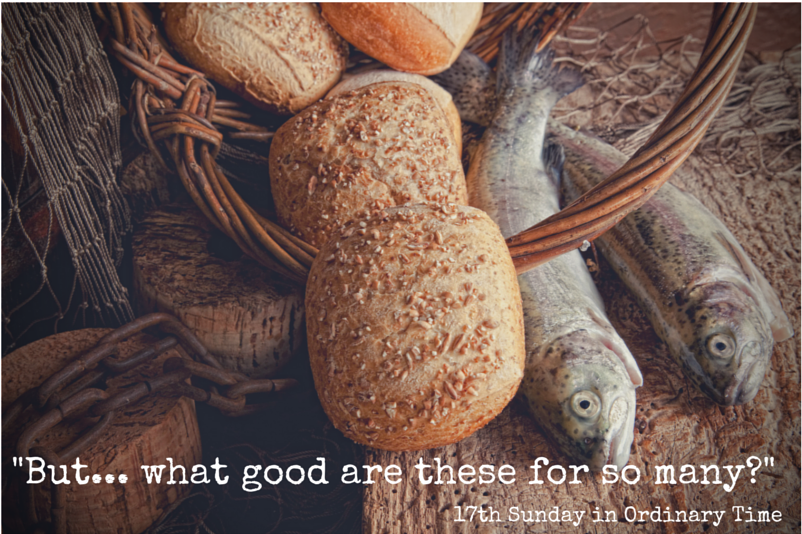
One of his disciples, Andrew, the brother of Simon Peter, said to him, “There is a boy here who has five barley loaves and two fish; but what good are these for so many?”
Andrew, known for bringing others to Jesus (John 1:41-42), tries to offer a potential solution, showing his proactive nature. But ultimately he is as baffled as Philip.
Neither of them realized the deeper meaning of Jesus’ words or what was happening.
Jesus said, “Have the people recline.”
The traditional posture for eating in Jesus’ time was lying down, usually on a special kind of couch, with the food placed on a table within reach.
It would have seemed ridiculous to have the people recline in preparation to eat when there was essentially nothing to eat. Jesus is basically saying, “Trust me.”
Now there was a great deal of grass in that place. So the men reclined, about five thousand in number.
Even in springtime (near Passover), having a “great deal” of grass would be peculiar, as this is a desert setting. Mentioning it creates a pastoral scene, reminiscent of Psalm 23. It also made the setting considerably more comfortable for dining.
Then Jesus took the loaves, gave thanks,
The Greek verb for “give thanks” is eucharistéō.
The language used here is similar across all four gospel accounts, and it strongly resembles the words Jesus used at the Last Supper, the institution of the Eucharist (Matthew 26:26; Mark 14:22; Luke 22:19; 1 Corinthians 11:25).
and distributed them to those who were reclining, and also as much of the fish as they wanted.
The synoptic gospels have the disciples distributing the food. Given the size of the crowds, this seems plausible; John’s bypassing this detail echoes the Last Supper, where Jesus did the distributing.
When they had had their fill,
Notice the abundance: The people were given “as much… as they wanted” until ”they had their fill.”
he said to his disciples, “Gather the fragments left over, so that nothing will be wasted.”
Jesus accompanies this demonstration of his power to provide (the idea that there would be any leftovers at all in this scenario is preposterous) with a lesson on the responsible and grateful management of resources (none of God’s gifts should go unused).
So they collected them, and filled twelve wicker baskets with fragments from the five barley loaves that had been more than they could eat.
An astonishing detail: There was many times more food left over than the amount they started with, and after five thousand men had eaten their fill!
Jesus has met the most basic human need, hunger, with largess and compassion. This is a testament to the bountiful generosity of God, who not only fills our cup, he makes it run over.
The number twelve signifies that there is enough left over to feed the whole church (twelve tribes, twelve apostles).
This miracle story is the only one found in all four gospels, and in each account, it carries Eucharistic overtones. John wrote his gospel somewhere between 10-30 years after the others and typically avoided repeating what the other three had already recorded.
When the people saw the sign he had done, they said, “This is truly the Prophet, the one who is to come into the world.”
The people now recognize Jesus as more than a wonder-worker; he has performed an act of God. This leads them to believe he is the long-awaited prophet foretold by Moses in Deuteronomy 18:15.
Although their understanding is not yet complete, they are beginning to grasp Jesus’ true significance.
Since Jesus knew that they were going to come and carry him off to make him king, he withdrew again to the mountain alone.
Once again highlighting Jesus’ divine omniscience, John tells us that Jesus knows the crowd wants to forcefully make him king.
However, Jesus’ mission is not to become a political leader but to fulfill a spiritual and redemptive purpose. His withdrawal signifies his unwavering commitment to His divine mission and timing.
Any attempt to alter his mission as God’s servant or his destiny to die on the cross was a temptation to be avoided.
Connections and Themes
- The Bread of Life discourse. All three readings today and in the next four weeks either expand or support the meaning of the Bread of Life discourse (John 6:22-59), one of Jesus’ most pivotal teachings — and have been chosen exactly for that reason.
- God provides. The first reading and the gospel passage both highlight the profound truth that God is our ultimate provider, a truth we often overlook. While we are responsible for caring for ourselves and others, everything we need is provided by God through the earth — food, water, materials for shelter, and clothing.
- Divine generosity. In the first reading from 2 Kings (4:42-44), Elisha performs a miracle by feeding a hundred people with just twenty barley loaves, demonstrating God’s ability to provide abundantly. This theme of divine generosity is further highlighted in the Gospel reading from John (6:1-15), where Jesus feeds five thousand men with only five loaves and two fish, showcasing God’s boundless provision.As amazing as that is, God’s generosity extends beyond merely meeting our needs; it encompasses an abundance that delights and enriches us. Life hums in diverse ecosystems, sunsets dazzle with their beauty, and flowers and fruit offer both nourishment and sensory pleasure. We must recognize that such abundance and joy are gifts we didn’t have to receive — they are expressions of God’s extraordinary generosity.
- Building community. In today’s individualistic society, we often overlook the importance of communal life. Both the first reading and the Gospel illustrate this communal aspect: in the first reading, the bread is shared with the people despite it being meant for only Elisha, while in the Gospel, Jesus similarly provides food for the multitude. Paul’s letter to the Ephesians calls for unity, reminding us that despite our individuality and God’s deep care for each person, we must remember that we would have never endured or developed without the care of others.
- Living as One. As members of this divine community, we are called to embody nobility and selflessness, embracing the virtues Paul describes. We are all united by the same Spirit of Jesus and bound together through God’s love. Therefore, we must live with gratitude, reflecting this unity and divine care in our actions.

 Sunday Readings