1st Reading – Wisdom 2:12,17-20
The wicked say:
Let us beset the just one, because he is obnoxious to us;
he sets himself against our doings,
reproaches us for transgressions of the law
and charges us with violations of our training.
Let us see whether his words be true;
let us find out what will happen to him.
For if the just one be the son of God, God will defend him
and deliver him from the hand of his foes.
With revilement and torture let us put the just one to the test
that we may have proof of his gentleness
and try his patience.
Let us condemn him to a shameful death;
for according to his own words, God will take care of him.
The Book of Wisdom was written in Greek about a hundred years before Christ’s birth. Its author, whose name is unknown, was a member of the Jewish community in Alexandria, Egypt, where the book is believed to have been composed.
The Book of Wisdom is an example of wisdom literature, which uses reason to explore the mysteries of faith. There are six books of Wisdom literature in the Old Testament: Job, Proverbs, Psalms, Ecclesiastes, Song of Songs, Sirach, and Wisdom (or The Wisdom of Solomon).
In this reading, evildoers put a just man to the test with abuse and torture. Many have understood Wisdom 2:12-20 as a direct prophecy of the Passion of Christ.
The wicked say: Let us beset the just one, because he is obnoxious to us; he sets himself against our doings, reproaches us for transgressions of the law and charges us with violations of our training.
The opening verse captures the mindset of the wicked.
The person they openly refer to as “the just one” lives according to God’s law and reproves the wicked for their transgressions.
The Greek word translated as “obnoxious” is enochlēsis, which means something is troublesome or disturbing. The mere presence of the just one brings discomfort to these evildoers.
Let us see whether his words be true; let us find out what will happen to him.
The wicked decide to put the just one to the test.
For if the just one be the son of God, he will defend him and deliver him from the hand of his foes.
In verse 13, which is not included in our reading, the wicked state that the just one has boasted that he is the son of God:
“He professes to have knowledge of God and styles himself a child of the LORD.”
(Note: While the Greek word pais (“child”) conveys a sense of belonging and divine favor, this claim of intimacy with God does not have the divine connotations that we associate with Jesus, the Son of God.)
The wicked mock the just one by suggesting that if his claims of God’s favor are true, then God will intervene and save him. In a certain way, this is a test of God as well; they are essentially daring God to act.
Jesus was similarly taunted on the cross: “He trusts in God; let God deliver him now” (Matthew 27:40-43; Mark 15:31-32; Luke 23:35-37).
With revilement and torture let us put him to the test that we may have proof of his gentleness and try his patience.
The wicked pre-meditate their torture of the righteous person, a deliberate attempt to provoke him into abandoning his faith.
They obviously do not believe that God will protect their victim and do not expect to be held accountable for their actions.
Let us condemn him to a shameful death; for according to his own words, God will take care of him.
The abuse being planned is extreme, even fatal.
The phrase “shameful death” indicates not just physical death, but humiliation and disgrace. In ancient Jewish society, which placed great value on honor and shame, a disgraceful death could severely damage the deceased’s reputation and, by extension, their family’s standing in the community.
This exploration of the arrogance and cruelty of the wicked helps us interpret this week’s gospel reading, where Jesus foretells his suffering and challenges his disciples’ misconceptions about greatness and leadership.
2nd Reading – James 3:16-4:3
Beloved:
Where jealousy and selfish ambition exist,
there is disorder and every foul practice.
But the wisdom from above is first of all pure,
then peaceable, gentle, compliant,
full of mercy and good fruits,
without inconstancy or insincerity.
And the fruit of righteousness is sown in peace
for those who cultivate peace.
Where do the wars
and where do the conflicts among you come from?
Is it not from your passions
that make war within your members?
You covet but do not possess.
You kill and envy but you cannot obtain;
you fight and wage war.
You do not possess because you do not ask.
You ask but do not receive,
because you ask wrongly, to spend it on your passions.
This week is the fourth installment of a five-part study of the Book of James.
Today’s reading is an example of wisdom teaching, where the path of the wise is contrasted with the path of the foolish (or sinful).
Beloved: Where jealousy and selfish ambition exist, there is disorder and every foul practice.
Unchecked selfishness opens the door to all kinds of sinful behavior.
The larger implication of this statement is that inner motivations matter; they are the root of outward actions.
But the wisdom from above is first of all pure, then peaceable, gentle, compliant, full of mercy and good fruits, without inconstancy or insincerity.
James contrasts worldly wisdom, which produces chaos, with divine wisdom, which is merciful and produces good works in abundance.
This “wisdom from above” is not gained from experience, it is a gift from God.
And the fruit of righteousness is sown in peace for those who cultivate peace.
James uses agricultural imagery to emphasize that righteousness grows in an environment of peace. Notice that peace is both the soil in which righteousness is sown and the fruit that grows from it.
Those who promote peace will harvest righteousness: a life aligned with God’s will.
Where do the wars and where do the conflicts among you come from? Is it not from your passions that make war within your members?
James pivots to a discussion of conflicts within the community.
The Greek for passions is hēdonōn, literally, “your pleasures”; i.e., self-centered desires that have created conflict and division.
The conflicts within the community are not caused by outside forces – they have no one to blame but themselves.
You covet but do not possess. You kill and envy but you cannot obtain; you fight and wage war.
James elaborates on the destructive consequences of unchecked desire, highlighting that coveting and envy ultimately lead to frustration. Even with fighting and war, they do not succeed. The path they have chosen is one of folly.
“You kill and envy” can be interpreted metaphorically, suggesting the deadly nature of envy and the lengths to which people will go when driven by selfish ambition.
You do not possess because you do not ask.
There is also a spiritual issue at hand: the failure to ask God in prayer for what is needed, indicating a lack of dependence on God and a reliance on one’s own efforts.
You ask but do not receive, because you ask wrongly, to spend it on your passions.
James rebukes those who pray with selfish motives, seeking to fulfill their personal desires rather than aligning their requests with God’s will.
This is essentially an inverse presentation of the gospel appeals to prayer (Matthew 7:7-11; Mark 11:24; John 14:13-14). While those appeals encourage believers to ask with confidence in God’s goodness, James warns that prayers motivated by selfishness or worldly passions are ineffective.
Ultimately the wayward believers in James’ audience must return to the foundation of their faith and choose the correct path: the path of wisdom.
In today’s gospel reading, Jesus similarly warns the apostles against selfish ambition.
Gospel – Mark 9:30-37
Jesus and his disciples left from there and began a journey through Galilee,
but he did not wish anyone to know about it.
He was teaching his disciples and telling them,
“The Son of Man is to be handed over to men
and they will kill him,
and three days after his death the Son of Man will rise.”
But they did not understand the saying,
and they were afraid to question him.
They came to Capernaum and, once inside the house,
he began to ask them,
“What were you arguing about on the way?”
But they remained silent.
They had been discussing among themselves on the way
who was the greatest.
Then he sat down, called the Twelve, and said to them,
“If anyone wishes to be first,
he shall be the last of all and the servant of all.”
Taking a child, he placed it in the their midst,
and putting his arms around it, he said to them,
“Whoever receives one child such as this in my name, receives me;
and whoever receives me,
receives not me but the One who sent me.”
Today’s gospel reading has two distinct parts: Jesus’ second prediction of his death and resurrection (we heard his first prediction last week), and the disciples’ argument about their status.
Although the two sections seem unrelated, their literary juxtaposition sharply contrasts Jesus’ mission of self-sacrifice and the disciples’ worldly thinking.
Jesus and his disciples left from there
and began a journey through Galilee, but he did not wish anyone to know about it.
This journey to Galilee provides time for Jesus to prepare the disciples for his impending death and resurrection. This teaching is critical; he likely wanted to avoid the distractions of the crowds and public ministry so that he could impart this important message in a more focused and intimate setting.
Jesus is also gradually making his way toward Jerusalem, where his Passion will take place.
He was teaching his disciples and telling them, “The Son of Man is to be handed over to men and they will kill him, and three days after his death he will rise.”
This is the second time Jesus explicitly predicts his Passion (the first is Mark 8:31). In both cases, he uses the title “Son of Man,” which echoes both his role as a suffering servant and a figure of glory from Daniel 7, while also emphasizing his resurrection.
But they did not understand the saying,
It’s not surprising that the disciples fail to understand. The idea that Jesus was the Son of Man, the person to whom God would give authority over other nations, was simply incompatible with the idea that Jesus would be killed.
and they were afraid to question him.
With startling brevity, Mark ends the story by citing their fear to ask Jesus to elaborate on his teaching.
This fear may stem from Jesus’ recent rebuke of Peter (“Get behind me, Satan!”, Mark 8:33), and/or Jesus’ exasperation after the disciples failed to exorcise a demon in Mark 9:19 (“O faithless generation, how long am I to be with you? How long am I to bear with you?”).
We can only guess, but it’s understandable that the disciples wouldn’t want to reveal yet another failure to grasp Jesus’ teachings.
They came to Capernaum and, once inside the house,
Capernaum is Jesus’ base of operations in Galilee (Matthew 4:13).
he began to ask them, “What were you arguing about on the way?” But they remained silent. They had been discussing among themselves on the way who was the greatest.
Jesus, fully aware of their conversation, draws the disciples into a teachable moment. The disciples have been arguing about their status and greatness, which contrasts sharply with the humility and suffering Jesus has just predicted.
Their silence shows they were aware of the inappropriateness of their argument.
Then he sat down, called the Twelve, and said to them,
Jesus does not reprimand them for their insensitivity and ignorance. Instead, he assumes the position of a teacher by sitting, indicating a formal moment of instruction.
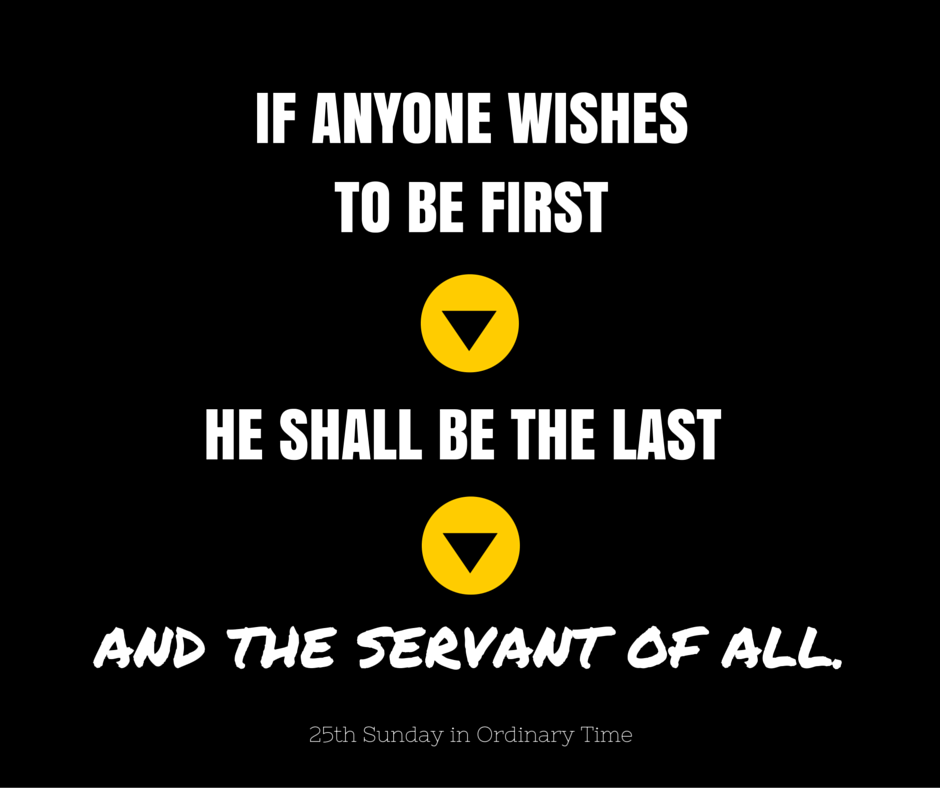
“If anyone wishes to be first, he shall be the last of all and the servant of all.”
Jesus corrects their misunderstanding of what “greatness” is in the kingdom of God by revealing the paradox of Christian leadership. True greatness comes from humility and service, not from seeking to be first or powerful.
This would have been revolutionary for them. The idea of servant leadership was a direct contradiction of their conventional understanding of status. Jesus has essentially turned the social ranking system of ancient Israel on its head.
A similar teaching occurs again in Mark 10:43-44.
Taking a child he placed it in their midst,
In Jesus’ time, neither children nor servants had any legal rights or social status. They were “non-persons,” powerless and often unprotected.
and putting his arms around it he said to them, “Whoever receives one child such as this in my name, receives me;
The great Messiah they have been longing for is identifying himself with the subordinate status of a child – an astounding expression of humility. No one is more vulnerable than a child.
By embracing the child, Jesus not only demonstrates compassion but also models the care and attention that should be given to the “least” in society. It’s a powerful visual representation of his teaching on servanthood and humility.
and whoever receives me, receives not me but the one who sent me.”
Jesus connects his teaching back to God: whoever receives the lowliest of the low receive Jesus, and whoever receives Jesus, receives God.
Connections and Themes
- True righteousness. This week’s readings explore the true nature of righteousness by contrasting the actions and attitudes of the just with those of the wicked. The first reading shows that righteousness often provokes opposition because it reveals the darkness in others. The second reading from James further clarifies righteousness by contrasting it with jealousy and selfish ambition, emphasizing that true righteousness is marked by peace, gentleness, and purity, not by discord or rivalry. In the gospel reading, Jesus provides the ultimate example of righteousness, predicting his own suffering and death for the sake of others and teaching that greatness in God’s eyes is found in humble service.
Together, these readings depict the righteous as those who live in accordance with God’s wisdom, reject selfish ambition, and embrace humility and self-sacrifice, even in the face of opposition.
- Pursuing righteousness. In our modern culture, the pursuit of wealth, fame, and beauty often takes precedence over seeking righteousness, wisdom, and humility. The allure of status and success dominates much of our thinking, leading us to admire and imitate those who excel by worldly standards. However, the readings for today challenge this mindset, revealing that righteousness is foundational in God’s kingdom. It’s easy to forget that true righteousness, characterized by humility, service, and sacrifice, is required for eternal life.
Jesus pulls no punches in today’s gospel reading: his followers must be willing to take the last place and be servant to all — even the lowliest of society.
- Staying true. Embracing righteousness requires a conscious effort to recognize and avoid the pitfalls that can lead us astray. When we compare ourselves to others and feel morally lacking, we must resist the temptation to challenge or discredit the other, as the wicked do in the first reading. We must seek righteousness ourselves, not persecute it in others.
We must also prevent our selfish desire for comfort or pleasure to dominate our decisions, as the second reading warns. Are we fighting for justice in our daily lives, or are we fighting to protect our selfish desires?
Finally, we must guard against seeking prestige or fame, as the apostles did in the Gospel. If we find ourselves wanting to be served rather than to serve, it is a clear sign that we are straying from the path of true righteousness.

 Sunday Readings