Introduction
Having begun the liturgy of the sacred Triduum yesterday with the Lord’s Supper, we now enter into the solemn mystery of Christ’s Passion and Death. Today’s readings draw us into the suffering of the Servant foretold by Isaiah, the obedience of Christ who offered himself for our salvation, and the stark, unflinching account of his crucifixion according to John. We listen with hearts open to the depth of divine love revealed on the Cross — a love that bears our sorrows and redeems the world.
1st Reading – Isaiah 52:13-53:12
See, my servant shall prosper,
he shall be raised high and greatly exalted.
Even as many were amazed at him—
so marred was his look beyond human semblance
and his appearance beyond that of the sons of man—
so shall he startle many nations,
because of him kings shall stand speechless;
for those who have not been told shall see,
those who have not heard shall ponder it.
Who would believe what we have heard?
To whom has the arm of the LORD been revealed?
He grew up like a sapling before him,
like a shoot from the parched earth;
there was in him no stately bearing to make us look at him,
nor appearance that would attract us to him.
He was spurned and avoided by people,
a man of suffering, accustomed to infirmity,
one of those from whom people hide their faces,
spurned, and we held him in no esteem.
Yet it was our infirmities that he bore,
our sufferings that he endured,
while we thought of him as stricken,
as one smitten by God and afflicted.
But he was pierced for our offenses,
crushed for our sins;
upon him was the chastisement that makes us whole,
by his stripes we were healed.
We had all gone astray like sheep,
each following his own way;
but the LORD laid upon him
the guilt of us all.
Though he was harshly treated, he submitted
and opened not his mouth;
like a lamb led to the slaughter
or a sheep before the shearers,
he was silent and opened not his mouth.
Oppressed and condemned, he was taken away,
and who would have thought any more of his destiny?
When he was cut off from the land of the living,
and smitten for the sin of his people,
a grave was assigned him among the wicked
and a burial place with evildoers,
though he had done no wrong
nor spoken any falsehood.
But the LORD was pleased
to crush him in infirmity.
If he gives his life as an offering for sin,
he shall see his descendants in a long life,
and the will of the LORD shall be accomplished through him.
Because of his affliction
he shall see the light in fullness of days;
through his suffering, my servant shall justify many,
and their guilt he shall bear.
Therefore I will give him his portion among the great,
and he shall divide the spoils with the mighty,
because he surrendered himself to death
and was counted among the wicked;
and he shall take away the sins of many,
and win pardon for their offenses.
Our first reading is one of the most poignant and theologically rich passages in the Old Testament, often referred to as Isaiah’s “Fourth Servant Song.”
Isaiah likely envisioned the servant as a representation of the people of Israel—especially those who endured the suffering of exile while continuing to trust that God would ultimately vindicate their faithfulness.
From the earliest days of Christianity, this passage has been understood as a prophetic foreshadowing of the passion, death, and redemptive mission of Jesus Christ.
See, my servant shall prosper, he shall be raised high and greatly exalted.
The account of the servant’s afflictions is framed with two divine utterances, declarations spoken by God.
The Servant’s ultimate vindication is declared at the outset: He shall be raised high and greatly exalted.
The servant’s exaltation is not a reward for his humiliation; rather, it is precisely in his humiliation that he is exalted.
Even as many were amazed at him — so marred was his look beyond human semblance and his appearance beyond that of the sons of man —
The Servant’s suffering and disfigurement are shocking. The brutality of what he has endured has rendered him unrecognizable.
so shall he startle many nations, because of him kings shall stand speechless; for those who have not been told shall see, those who have not heard shall ponder it.
The Servant’s suffering, though initially a cause of horror, becomes a source of awe and revelation for the nations. The imagery of silenced kings points to the universality of the Servant’s impact.
Who would believe what we have heard? To whom has the arm of the LORD been revealed?
The divine proclamation concludes, and the perspective shifts. The voice now speaks in the first-person plural — those who have received salvation through the servant’s suffering reflect with awe and recognition.
It begins with an exclamation of total amazement. Who would have ever thought that the power of God (“the arm of the Lord”) would be revealed in weakness and humiliation?
He grew up like a sapling before him, like a shoot from the parched earth; there was in him no stately bearing to make us look at him, nor appearance that would attract us to him.
The Servant’s humble origins and unimpressive outward appearance contrast with expectations of a mighty deliverer.
He was spurned and avoided by people, a man of suffering, accustomed to infirmity, one of those from whom people hide their faces, spurned, and we held him in no esteem.
A vivid portrayal of physical, social, and spiritual abandonment.
Yet it was our infirmities that he bore, our sufferings that he endured, while we thought of him as stricken, as one smitten by God and afflicted.
The wounds suffered by the servant encompass physical, mental, emotional, and spiritual anguish, representing the burden of sin and its consequences.
The Servant suffers on behalf of others, though misunderstood as being punished by God.
But he was pierced for our offenses, crushed for our sins; upon him was the chastisement that makes us whole, by his stripes we were healed.
A theological climax. The Servant’s pain brings healing. Notice how each phrase articulates the redemptive nature of his suffering.
Notice also the narrator’s movement toward this insight: “We thought of him as stricken” becomes “He was pierced for our offenses.”
A profound theological truth has been revealed: an innocent person can suffer not because of any fault of their own, but as part of a divine purpose that brings healing to others. This is a major turning point in Scripture, revealing that the suffering of one individual can become a channel of grace and restoration for others.
We had all gone astray like sheep, each following his own way; but the LORD laid upon him the guilt of us all.
The metaphor of sheep reflects our human tendency to stray from God’s will.
Though he was harshly treated, he submitted and opened not his mouth; like a lamb led to the slaughter or a sheep before the shearers, he was silent and opened not his mouth. Oppressed and condemned, he was taken away, and who would have thought any more of his destiny?
The account of the servant’s suffering continues, with a clear portrayal of his non-violent attitude. He did not retaliate; he did not even defend himself. In fact, he willingly handed himself over to those who afflicted him.
The image of a lamb being led to slaughter suggests that the servant knew that he would die at the hands of his persecutors. Still, he chose to be defenseless.
When he was cut off from the land of the living, and smitten for the sin of his people, a grave was assigned him among the wicked and a burial place with evildoers, though he had done no wrong nor spoken any falsehood.
Even in death he was shamed, buried with the wicked.
But the LORD was pleased to crush him in infirmity.
The servant’s pain and death are not accidental or merely the result of human evil, but part of God’s divine plan.
If he gives his life as an offering for sin, he shall see his descendants in a long life, and the will of the LORD shall be accomplished through him.
The Hebrew term ’asham (“offering for sin”) denotes a particular kind of sacrifice, one that is intended as compensation for that which is due because of guilt (see Leviticus 5:14-26). Here, the servant offers himself, much like a guilt offering, to reconcile humanity with God.
In this light, the reason for the Lord’s delight is clear: This death will win life for others, and life is God’s will for his people.
Because of his affliction he shall see the light in fullness of days;
The servant’s anguish will ultimately lead to restoration and vindication, with the light symbolizing life, renewal, and divine favor. The phrase “fullness of days” suggests an abundance of spiritual graces.
There was nothing in the servant’s appalling life or death to indicate the significance of this suffering, its redemptive value, or the source of exaltation it would become. God’s ways are astounding.
through his suffering, my servant shall justify many, and their guilt he shall bear.
God speaks again, interpreting the meaning and reward of the Servant’s suffering — and offering divine vindication and exaltation.
The verb yatzdiq (“justify”) means “to be acquitted,” “declared innocent,” referring to a legal judgment of righteousness or innocence.
Therefore I will give him his portion among the great, and he shall divide the spoils with the mighty,
The imagery of receiving a portion among the great and dividing the spoils echoes the language of victory after battle. But in this case, the “victory” was won through suffering, submission, and sacrifice, not force.
This is a complete reversal of expectations: The Servant triumphs not by killing enemies but by bearing their sins.
because he surrendered himself to death and was counted among the wicked; and he shall take away the sins of many, and win pardon for their offenses.
The will of God is accomplished in the servant’s willingness to bear his afflictions at the hands of, and for the sake of, others.
“The Prophet [Isaiah], who has rightly been called “the Fifth Evangelist,” presents in this Song an image of the sufferings of the Servant with a realism as acute as if he were seeing them with his own eyes: the eyes of the body and of the spirit. […] The Song of the Suffering Servant contains a description in which it is possible, in a certain sense, to identify the stages of Christ’s Passion in their various details: the arrest, the humiliation, the blows, the spitting, the contempt for the prisoner, the unjust sentence, and then the scourging, the crowning with thorns and the mocking, the carrying of the Cross, the crucifixion and the agony” (Saint Pope John Paul II, Salvifici Doloris, 17).
2nd Reading – Hebrews 4:14-16; 5:7-9
Brothers and sisters:
Since we have a great high priest who has passed through the heavens,
Jesus, the Son of God,
let us hold fast to our confession.
For we do not have a high priest
who is unable to sympathize with our weaknesses,
but one who has similarly been tested in every way,
yet without sin.
So let us confidently approach the throne of grace
to receive mercy and to find grace for timely help.
In the days when Christ was in the flesh,
he offered prayers and supplications with loud cries and tears
to the one who was able to save him from death,
and he was heard because of his reverence.
Son though he was, he learned obedience from what he suffered;
and when he was made perfect,
he became the source of eternal salvation for all who obey him.
To the passersby and onlookers at Golgotha, Jesus’ crucifixion was simply the execution of another criminal, condemned to die a shameful and brutal death reserved for slaves and the lowest of society. Nothing about the scene suggested sacrifice in the religious or redemptive sense.
And yet, in light of the Resurrection, the early Christian community came to understand Jesus’ death not merely as a sacrifice, but as the sacrifice—so profound and transformative that it redefined the very meaning of sacrifice itself.
Brothers and sisters: Since we have a great high priest
This is the only place in the Letter to the Hebrews where Jesus is designated a “great” high priest. The author is making a theological argument that Jesus fulfills and surpasses the roles and functions of the Old Covenant, especially that of the high priest.
who has passed through the heavens,
In Jewish liturgical tradition, the high priest could enter the Holy of Holies in the Temple only once a year, on the Day of Atonement, passing through the veil to intercede for the sins of the people.
Just as the high priest passed through the veil to enter into the Holy of Holies, so Christ passed through the heavens into the presence of God, where he remains for all time.
As a result, the risen Christ is the high priest who can intercede for us as no other priest ever could.
Jesus, the Son of God,
Jesus is not only the great high priest but also the eternal Son of God. His divine identity gives weight and efficacy to his priestly action.
let us hold fast to our confession.
The “confession” here refers to the proclamation of faith: “Jesus is Lord” (cf. Romans 10:9; 1 Corinthians 12:3). This is not merely a verbal profession but a lived fidelity.
This call to perseverance is in the identity and faithfulness of Christ himself.
For we do not have a high priest who is unable to sympathize with our weaknesses, but one who has similarly been tested in every way, yet without sin.
Christ’s exalted position has not distanced him from human experience. On the contrary, he knows our limitations intimately, being fully human in all ways except sin. He was tempted in the desert (Matthew 4:1-11) and throughout his life (Luke 22:28).
This underscores the mystery of the Incarnation: Jesus is fully God and fully man. These two natures are united in the one divine person of Christ. As a man, he stands in solidarity with us; as God, he bridges the chasm sin created. Because he shares our nature, he can truly represent us before the Father, and because he is divine, he can truly reconcile us to God.
So let us confidently approach the throne of grace to receive mercy and to find grace for timely help.
Under the Old Covenant, only the high priest could approach the mercy seat, and only once a year. But through Christ, the veil is torn, and the way to the Father is opened to all.
In the days when Christ was in the flesh,
An allusion to Jesus’ humanity. In biblical language, “flesh” (sárx) is not inherently evil but is fraught with limitations and weaknesses. Because it is subject to deterioration and death, it came to signify many things associated with human frailty, such as vulnerability and fear.
Christ willingly embraced our frailty — not as a facade, but in full reality.
he offered prayers and supplications with loud cries and tears to the one who was able to save him from death, and he was heard because of his reverence.
The reference to Jesus’ anguished prayer calls to mind his agony in Gethsemane, where he prayed with deep emotion (Matthew 26:36-46; Mark 14:32-42; Luke 22:40-46). It also reflects the Jewish understanding of the righteous one crying out to God in distress, as seen in the Psalms (e.g., Psalms 22, 31, 38).
These prayers were not merely emotional outpourings; they were priestly acts. In them, Jesus offered his anguish as part of his saving work.
Son though he was, he learned obedience from what he suffered; and when he was made perfect, he became the source of eternal salvation for all who obey him.
Though he was the Son of God, Jesus learned what every human has to learn, namely, acceptance of God’s will in the circumstances of life. The surest way to learn this lesson, though perhaps the hardest, is through suffering.
This notion points again to Jesus’ willingness to assume every aspect of human nature. As mediator of salvation, Jesus endured torment of body and anguish of soul. He knew agony, terror, and depression. He could fully understand human distress and the desire to escape it.
Through his perfect self-offering, he opened the way to eternal life, becoming for all time the high priest who leads us into the presence of God.
Gospel – John 18:1-19:42
Jesus went out with his disciples across the Kidron valley
to where there was a garden,
into which he and his disciples entered.
Judas his betrayer also knew the place,
because Jesus had often met there with his disciples.
So Judas got a band of soldiers and guards
from the chief priests and the Pharisees
and went there with lanterns, torches, and weapons.
Jesus, knowing everything that was going to happen to him,
went out and said to them, “Whom are you looking for?”
They answered him, “Jesus the Nazorean.”
He said to them, “I AM.”
Judas his betrayer was also with them.
When he said to them, “I AM, ”
they turned away and fell to the ground.
So he again asked them,
“Whom are you looking for?”
They said, “Jesus the Nazorean.”
Jesus answered,
“I told you that I AM.
So if you are looking for me, let these men go.”
This was to fulfill what he had said,
“I have not lost any of those you gave me.”
Then Simon Peter, who had a sword, drew it,
struck the high priest’s slave, and cut off his right ear.
The slave’s name was Malchus.
Jesus said to Peter,
“Put your sword into its scabbard.
Shall I not drink the cup that the Father gave me?”
So the band of soldiers, the tribune, and the Jewish guards seized Jesus,
bound him, and brought him to Annas first.
He was the father-in-law of Caiaphas,
who was high priest that year.
It was Caiaphas who had counseled the Jews
that it was better that one man should die rather than the people.
Simon Peter and another disciple followed Jesus.
Now the other disciple was known to the high priest,
and he entered the courtyard of the high priest with Jesus.
But Peter stood at the gate outside.
So the other disciple, the acquaintance of the high priest,
went out and spoke to the gatekeeper and brought Peter in.
Then the maid who was the gatekeeper said to Peter,
“You are not one of this man’s disciples, are you?”
He said, “I am not.”
Now the slaves and the guards were standing around a charcoal fire
that they had made, because it was cold,
and were warming themselves.
Peter was also standing there keeping warm.
The high priest questioned Jesus
about his disciples and about his doctrine.
Jesus answered him,
“I have spoken publicly to the world.
I have always taught in a synagogue
or in the temple area where all the Jews gather,
and in secret I have said nothing. Why ask me?
Ask those who heard me what I said to them.
They know what I said.”
When he had said this,
one of the temple guards standing there struck Jesus and said,
“Is this the way you answer the high priest?”
Jesus answered him,
“If I have spoken wrongly, testify to the wrong;
but if I have spoken rightly, why do you strike me?”
Then Annas sent him bound to Caiaphas the high priest.
Now Simon Peter was standing there keeping warm.
And they said to him,
“You are not one of his disciples, are you?”
He denied it and said,
“I am not.”
One of the slaves of the high priest,
a relative of the one whose ear Peter had cut off, said,
“Didn’t I see you in the garden with him?”
Again Peter denied it.
And immediately the cock crowed.
Then they brought Jesus from Caiaphas to the praetorium.
It was morning.
And they themselves did not enter the praetorium,
in order not to be defiled so that they could eat the Passover.
So Pilate came out to them and said,
“What charge do you bring against this man?”
They answered and said to him,
“If he were not a criminal,
we would not have handed him over to you.”
At this, Pilate said to them,
“Take him yourselves, and judge him according to your law.”
The Jews answered him,
“We do not have the right to execute anyone, ”
in order that the word of Jesus might be fulfilled
that he said indicating the kind of death he would die.
So Pilate went back into the praetorium
and summoned Jesus and said to him,
“Are you the King of the Jews?”
Jesus answered,
“Do you say this on your own
or have others told you about me?”
Pilate answered,
“I am not a Jew, am I?
Your own nation and the chief priests handed you over to me.
What have you done?”
Jesus answered,
“My kingdom does not belong to this world.
If my kingdom did belong to this world,
my attendants would be fighting
to keep me from being handed over to the Jews.
But as it is, my kingdom is not here.”
So Pilate said to him,
“Then you are a king?”
Jesus answered,
“You say I am a king.
For this I was born and for this I came into the world,
to testify to the truth.
Everyone who belongs to the truth listens to my voice.”
Pilate said to him, “What is truth?”
When he had said this,
he again went out to the Jews and said to them,
“I find no guilt in him.
But you have a custom that I release one prisoner to you at Passover.
Do you want me to release to you the King of the Jews?”
They cried out again,
“Not this one but Barabbas!”
Now Barabbas was a revolutionary.
Then Pilate took Jesus and had him scourged.
And the soldiers wove a crown out of thorns and placed it on his head,
and clothed him in a purple cloak,
and they came to him and said,
“Hail, King of the Jews!”
And they struck him repeatedly.
Once more Pilate went out and said to them,
“Look, I am bringing him out to you,
so that you may know that I find no guilt in him.”
So Jesus came out,
wearing the crown of thorns and the purple cloak.
And he said to them, “Behold, the man!”
When the chief priests and the guards saw him they cried out,
“Crucify him, crucify him!”
Pilate said to them,
“Take him yourselves and crucify him.
I find no guilt in him.”
The Jews answered,
“We have a law, and according to that law he ought to die,
because he made himself the Son of God.”
Now when Pilate heard this statement,
he became even more afraid,
and went back into the praetorium and said to Jesus,
“Where are you from?”
Jesus did not answer him.
So Pilate said to him,
“Do you not speak to me?
Do you not know that I have power to release you
and I have power to crucify you?”
Jesus answered him,
“You would have no power over me
if it had not been given to you from above.
For this reason the one who handed me over to you
has the greater sin.”
Consequently, Pilate tried to release him; but the Jews cried out,
“If you release him, you are not a Friend of Caesar.
Everyone who makes himself a king opposes Caesar.”
When Pilate heard these words he brought Jesus out
and seated him on the judge’s bench
in the place called Stone Pavement, in Hebrew, Gabbatha.
It was preparation day for Passover, and it was about noon.
And he said to the Jews,
“Behold, your king!”
They cried out,
“Take him away, take him away! Crucify him!”
Pilate said to them,
“Shall I crucify your king?”
The chief priests answered,
“We have no king but Caesar.”
Then he handed him over to them to be crucified.
So they took Jesus, and, carrying the cross himself,
he went out to what is called the Place of the Skull,
in Hebrew, Golgotha.
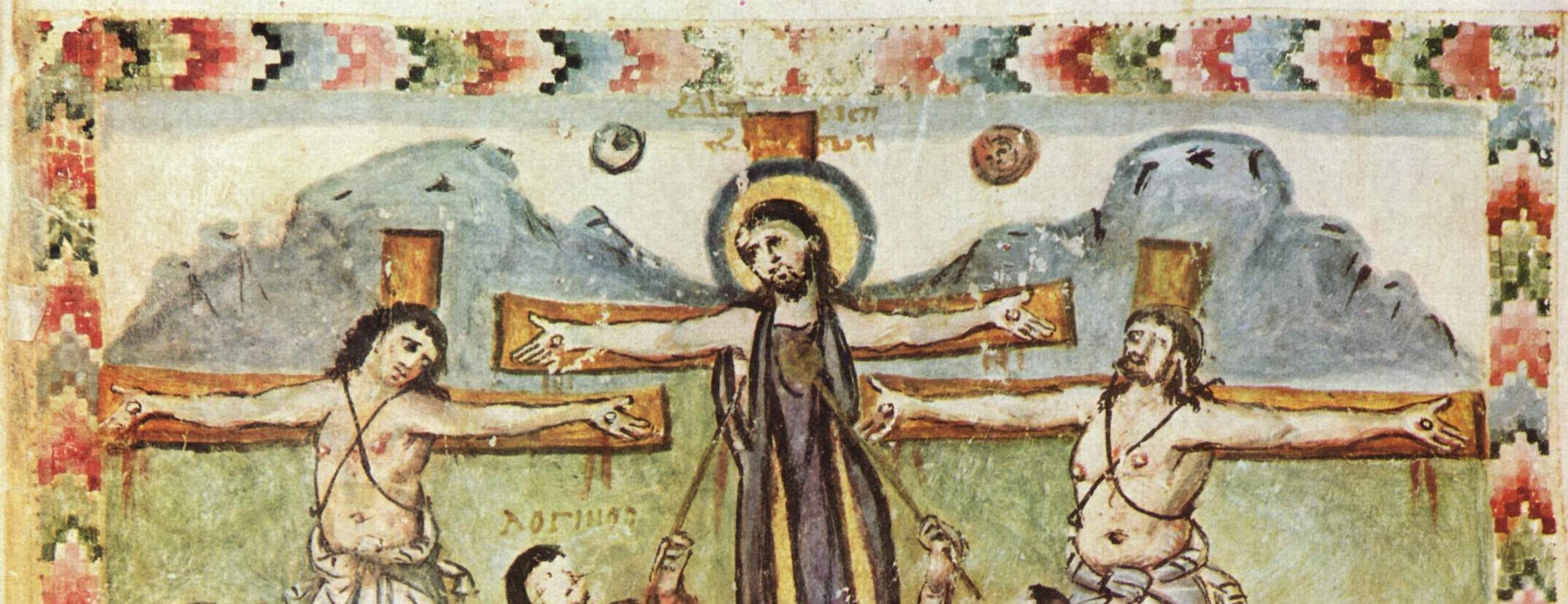
There they crucified him, and with him two others,
one on either side, with Jesus in the middle.
Pilate also had an inscription written and put on the cross.
It read,
“Jesus the Nazorean, the King of the Jews.”
Now many of the Jews read this inscription,
because the place where Jesus was crucified was near the city;
and it was written in Hebrew, Latin, and Greek.
So the chief priests of the Jews said to Pilate,
“Do not write ‘The King of the Jews,’
but that he said, ‘I am the King of the Jews’.”
Pilate answered,
“What I have written, I have written.”
When the soldiers had crucified Jesus,
they took his clothes and divided them into four shares,
a share for each soldier.
They also took his tunic, but the tunic was seamless,
woven in one piece from the top down.
So they said to one another,
“Let’s not tear it, but cast lots for it to see whose it will be, ”
in order that the passage of Scripture might be fulfilled that says:
They divided my garments among them,
and for my vesture they cast lots.
This is what the soldiers did.
Standing by the cross of Jesus were his mother
and his mother’s sister, Mary the wife of Clopas,
and Mary of Magdala.
When Jesus saw his mother and the disciple there whom he loved
he said to his mother, “Woman, behold, your son.”
Then he said to the disciple,
“Behold, your mother.”
And from that hour the disciple took her into his home.
After this, aware that everything was now finished,
in order that the Scripture might be fulfilled,
Jesus said, “I thirst.”
There was a vessel filled with common wine.
So they put a sponge soaked in wine on a sprig of hyssop
and put it up to his mouth.
When Jesus had taken the wine, he said,
“It is finished.”
And bowing his head, he handed over the spirit.
[Here all kneel and pause for a short time.]
Now since it was preparation day,
in order that the bodies might not remain on the cross on the sabbath,
for the sabbath day of that week was a solemn one,
the Jews asked Pilate that their legs be broken
and that they be taken down.
So the soldiers came and broke the legs of the first
and then of the other one who was crucified with Jesus.
But when they came to Jesus and saw that he was already dead,
they did not break his legs,
but one soldier thrust his lance into his side,
and immediately blood and water flowed out.
An eyewitness has testified, and his testimony is true;
he knows that he is speaking the truth,
so that you also may come to believe.
For this happened so that the Scripture passage might be fulfilled:
Not a bone of it will be broken.
And again another passage says:
They will look upon him whom they have pierced.
After this, Joseph of Arimathea,
secretly a disciple of Jesus for fear of the Jews,
asked Pilate if he could remove the body of Jesus.
And Pilate permitted it.
So he came and took his body.
Nicodemus, the one who had first come to him at night,
also came bringing a mixture of myrrh and aloes
weighing about one hundred pounds.
They took the body of Jesus
and bound it with burial cloths along with the spices,
according to the Jewish burial custom.
Now in the place where he had been crucified there was a garden,
and in the garden a new tomb, in which no one had yet been buried.
So they laid Jesus there because of the Jewish preparation day;
for the tomb was close by.
The Passion according to John, traditionally read on Good Friday, has been part of the Church’s liturgy since the earliest centuries.
John’s account differs notably from the synoptic Gospels. It omits familiar elements such as Jesus’ agony in the garden, Judas’ kiss, the disciples’ flight, the Sanhedrin trial, mocking crowds, and the cry of abandonment from the cross. There is no darkness at his death, no good thief, and no account of Judas’ demise.
Instead, John presents a distinctive theological portrait: Jesus remains in full control of the events leading to his death. He is not a passive victim, but a sovereign figure whose kingship is revealed throughout, culminating in his exaltation on the cross.
Jesus went out with his disciples across the Kidron valley to where there was a garden, into which he and his disciples entered.
The Kidron Valley, literally “the winter-flowing Kidron,” is a wadi that only holds water during the rainy season. It lies between Jerusalem and the Mount of Olives and was lined with gardens, one of which Jesus enters after crossing.
Jesus often retired to the Mount of Olives after a day in the city, and he doesn’t break this routine, even knowing what awaits. His choice to remain predictable may have spared others from violence had he been seized in the city.
John is the only evangelist to mention that Jesus entered a garden — likely a deliberate echo of Eden. Here, Jesus, the new Adam, freely chooses obedience in a garden, in contrast to Adam’s disobedience in the first.
Judas his betrayer also knew the place, because Jesus had often met there with his disciples.
The name Judas is the Greek form of Judah (“praised”), a name found throughout Scripture.
Among the Twelve, there were two Judases; hence the explicit identification as “his betrayer.”
So Judas got a band of soldiers and guards from the chief priests and the Pharisees and went there with lanterns, torches, and weapons.
The Greek spira refers to a Roman cohort—typically 600 soldiers, though likely a detachment of 200 in this case, suggesting Roman collaboration even before Jesus is brought to Pilate.
The “guards from the chief priests” are Temple police, representing the chief priests and Pharisees.
Jesus faces a large, well-armed group, while his friends are few.
The lanterns and torches highlight the fact that this is the hour of darkness.
Jesus, knowing everything that was going to happen to him, went out and said to them, “Whom are you looking for?”
With calm authority, Jesus steps forward. Despite the crowd’s size, he initiates the encounter, underscoring that he is not a victim, but a willing participant.
They answered him, “Jesus the Nazorean.” He said to them, “I AM.”
His response, Ego eimi (“I AM”) — echoes the divine name revealed in Exodus 3:14. This detail would not have been lost on the crowd.
Judas his betrayer was also with them.
It must have been devastating for the apostles to see one of their own with Jesus’ enemies.
When he said to them, “I AM,” they turned away and fell to the ground.
A brief but powerful manifestation of divine authority: his spoken word knocks them backward. It underscores that Jesus could easily escape or destroy them, if he chose.
So he again asked them, “Whom are you looking for?” They said, “Jesus the Nazorean.” Jesus answered, “I told you that I AM. So if you are looking for me, let these men go.”
Jesus protects his disciples, insisting they be released. This is not a plea but a command; he remains in control.
This was to fulfill what he had said, “I have not lost any of those you gave me.”
See John 6:39, 10:28, 17:12.
Then Simon Peter, who had a sword, drew it, struck the high priest’s slave, and cut off his right ear. The slave’s name was Malchus.
The slave’s name is noted for the greater certainty of the account.
It’s likely that Peter was aiming for the top of his head and missed, cutting off his ear. His zeal is admirable but misguided.
Jesus said to Peter, “Put your sword into its scabbard. Shall I not drink the cup that the Father gave me?”
Note that Peter’s brash action occurs immediately after Jesus’ appeal to have them set free. Christ has set his intent to do his Father’s will by suffering and dying, an event which he foretold to Peter and the others more than once. Whether he intends to or not, at this point Peter is directly opposing Jesus’ wishes.
Luke’s account tells us Jesus touched the slave’s ear and healed him instantly (Luke 22:50-51).
So the band of soldiers, the tribune, and the Jewish guards seized Jesus, bound him,
Mark’s gospel tells us that at this point, all his disciples deserted him and fled (Mark 14:50).
and brought him to Annas first. He was the father-in-law of Caiaphas, who was high priest that year.
John alone mentions this preliminary hearing before Annas; Caiaphas and the Sanhedrin await at his home.
Annas may have been too old or unwell to attend, or Caiaphas may have honored his father-in-law, the former high priest, with a private audience.
It was Caiaphas who had counseled the Jews that it was better that one man should die rather than the people.
See John 11:47-53.
Simon Peter and another disciple followed Jesus. Now the other disciple was known to the high priest, and he entered the courtyard of the high priest with Jesus. But Peter stood at the gate outside.
After initially fleeing, Peter and another disciple follow at a distance. When Peter finds that he cannot enter the courtyard, he stands just outside the gate, as close as he can get to Jesus. There is clearly inner turmoil for Peter, who is terrified of what is happening, but also wants to know what becomes of Jesus and desires to fulfill the promises he has made to stand by him.
The unnamed disciple is traditionally thought to be John, but how a Galilean fisherman would be known to the high priest is unclear.
So the other disciple, the acquaintance of the high priest, went out and spoke to the gatekeeper and brought Peter in.
It’s courageous for Peter to come at all, especially after severing the ear of the high priest’s servant.
Then the maid who was the gatekeeper said to Peter, “You are not one of this man’s disciples, are you?” He said, “I am not.”
Peter’s first denial of Christ, just as Jesus had foretold (John 13:36-38).
Now the slaves and the guards were standing around a charcoal fire that they had made, because it was cold, and were warming themselves. Peter was also standing there keeping warm.
It’s cold, being early spring and past midnight. Peter does his best to blend in with the slaves and guards in the courtyard.
The high priest questioned Jesus about his disciples and about his doctrine.
He is seeking information that would implicate Jesus in a crime, such as gathering followers for a revolt against Rome (his disciples) or blasphemy (his doctrine).
Jesus answered him, “I have spoken publicly to the world. I have always taught in a synagogue or in the temple area where all the Jews gather, and in secret I have said nothing. Why ask me? Ask those who heard me what I said to them. They know what I said.”
In John’s gospel, Jesus is not silent during his two trials but engages in dialogue with both Annas and Pilate.
Jesus highlights the openness of his ministry. There’s no secret teaching. As the accused, he should not be compelled to testify against himself.
When he had said this, one of the temple guards standing there struck Jesus and said, “Is this the way you answer the high priest?” Jesus answered him, “If I have spoken wrongly, testify to the wrong; but if I have spoken rightly, why do you strike me?”
Jesus remains composed and challenges the illegality of the guard’s action.
If they had any evidence that Jesus’ teachings were blasphemous, they should submit that evidence. If his teachings were not blasphemous, he did not deserve this kind of treatment.
Then Annas sent him bound to Caiaphas the high priest. Now Simon Peter was standing there keeping warm. And they said to him, “You are not one of his disciples, are you?” He denied it and said, “I am not.”
Peter’s second denial.
One of the slaves of the high priest, a relative of the one whose ear Peter had cut off, said, “Didn’t I see you in the garden with him?” Again Peter denied it. And immediately the cock crowed.
Peter’s third and final denial. The synoptic gospels add that Peter immediately remembered Jesus’ words and wept bitterly (Matthew 26:75; Mark 14:72; Luke 22:61-62).
Then they brought Jesus from Caiaphas to the praetorium.
The praetorium was the official residence and military headquarters of a Roman governor, where he had his guard and held court.
It was morning.
A night trial involving serious charges, like blasphemy or threatening the temple, would have violated typical Jewish legal procedure, especially if it led directly to a death sentence.
Therefore, the Sanhedrin waits until morning to take further action.
And they themselves did not enter the praetorium, in order not to be defiled so that they could eat the Passover.
Entering a Gentile dwelling would render them ritually unclean for the Passover feast.
This is ironic, given they’re about to condemn the true Paschal Lamb.
So Pilate came out to them and said, “What charge do you bring against this man?”
Pontius Pilate was the governor of Judea at this time, the ranking Roman official of the land. The Jewish leaders brought Jesus before him because, being under Roman law, they could not carry out capital punishment on their own.
They were seeking a public sentence of death to discredit Jesus and erase his teaching from the people’s minds.
They answered and said to him, “If he were not a criminal, we would not have handed him over to you.” At this, Pilate said to them, “Take him yourselves, and judge him according to your law.” The Jews answered him, “We do not have the right to execute anyone,”
The Jewish leaders insinuate that Jesus was guilty of a serious crime, one punishable under Roman law — something that would concern Caesar’s court.
in order that the word of Jesus might be fulfilled that he said indicating the kind of death he would die.
John recalls Jesus’ earlier prediction of his own death:
While Jesus was going up to Jerusalem, he took the twelve disciples aside by themselves, and said to them on the way, “See, we are going up to Jerusalem, and the Son of Man will be handed over to the chief priests and scribes, and they will condemn him to death; then they will hand him over to the Gentiles to be mocked and flogged and crucified; and on the third day he will be raised” (Matthew 20:19).
So Pilate went back into the praetorium and summoned Jesus and said to him, “Are you the King of the Jews?”
The title of king will play a pivotal role throughout this scene and is the center of the interaction with Pilate.
It is unclear whether Pilate had previously heard that Jesus and/or his followers had claimed royalty, or whether the Jews had suggested to Pilate was his crime. Based on Jesus’ admission to the high priest that he was the Messiah, it is likely the latter.
Regardless, the question obviously affected the position of Caesar, which is Pilate’s focus and priority.
Jesus answered, “Do you say this on your own or have others told you about me?”
Jesus points out the obvious. He had never done anything to arouse Roman suspicion—he held no secular power, led no military force, and never spoke or acted in a way that could be construed as rebellion.
Given that, Pilate must have received this accusation from others. The implication here is that, as a judge, Pilate should be suspicious of the motives of anyone who would try to manipulate him into using his power as governor.
Pilate answered, “I am not a Jew, am I? Your own nation and the chief priests handed you over to me. What have you done?”
Pilate either misses the nuances of Jesus’ words or sidesteps the challenge; he presses on.
Jesus answered, “My kingdom does not belong to this world. If my kingdom did belong to this world, my attendants would be fighting to keep me from being handed over to the Jews. But as it is, my kingdom is not here.” So Pilate said to him, “Then you are a king?”
Pilate is laser-focused on this issue. Failing to address a potential rival to Caesar would carry a heavy punishment from Rome.
Jesus answered, “You say I am a king. For this I was born and for this I came into the world, to testify to the truth. Everyone who belongs to the truth listens to my voice.”
The purpose of Jesus’ life, from his miraculous birth to his public ministry, was to bear witness to the truth.
Pilate said to him, “What is truth?”
The irony here is that Truth is literally standing before him: Jesus Christ himself is truth. He is true God, and true man.
When he had said this, he again went out to the Jews and said to them, “I find no guilt in him.
Pilate, experienced with violent revolutionaries, sees clearly that Jesus poses no threat to the Roman Empire.
But you have a custom that I release one prisoner to you at Passover. Do you want me to release to you the King of the Jews?”
The custom of releasing a prisoner at Passover is not attested to outside the gospels.
They cried out again, “Not this one but Barabbas!” Now Barabbas was a revolutionary.
Barabbas is a notorious insurrectionist.
There is deep symbolism in this moment: Barabbas means “son of the father.” The crowd chooses this false “son of the father” — a man of violence and vengeance — over Jesus, The Son of The Father, who brings peace and forgiveness.
Then Pilate took Jesus and had him scourged.
Roman scourging was brutal. The prisoner was stripped and tied to a post. The whip — called a flagrum — had multiple leather thongs embedded with bone or metal, designed to tear flesh with each blow.
Many prisoners died from the scourging alone.
And the soldiers wove a crown out of thorns and placed it on his head, and clothed him in a purple cloak,
This is a mockery; a cruel costume meant to ridicule his claim to kingship.
and they came to him and said, “Hail, King of the Jews!” And they struck him repeatedly.
This scene represents the height of Jesus’ humiliation. The soldiers’ taunts mimic the royal greeting normally reserved for the emperor (“Hail, Caesar!”).
Their mock homage reveals a deeper truth than they realize: Jesus is the King. What they do in jest, the world will come to proclaim in faith.
Once more Pilate went out and said to them, “Look, I am bringing him out to you, so that you may know that I find no guilt in him.” So Jesus came out, wearing the crown of thorns and the purple cloak. And he said to them, “Behold, the man!”
Pilate once again affirms Jesus’ innocence. By presenting him in this degraded state, he likely hoped to evoke pity and end the matter.
When the chief priests and the guards saw him they cried out, “Crucify him, crucify him!”
Crucifixion was a torturous execution method adopted by Rome from the East. It was so horrible that it was prohibited by Roman law to crucify Roman citizens.
Victims were often first scourged, then usually nailed through the wrists (not palms), suspended in a way that made breathing painful and nearly impossible. Death could take hours — or even days.
Pilate said to them, “Take him yourselves and crucify him. I find no guilt in him.”
A third declaration of innocence by Pilate.
The Jews answered, “We have a law, and according to that law he ought to die, because he made himself the Son of God.”
Since the political charge wasn’t enough, they escalate the accusation: Referencing the law of Moses, they add the charge of Jesus claiming to be divine.
Now when Pilate heard this statement, he became even more afraid,
In Roman ideology, the emperor himself was considered divine. If Jesus was somehow divine, he is all the more threat to Caesar.
and went back into the praetorium and said to Jesus, “Where are you from?” Jesus did not answer him.
Jesus’ silence is not weakness — it’s deliberate. If he were seeking to save his own life, now would be the time to speak, but he had determined to lay down his life. He is patiently submitting to the Father’s will.
He was oppressed, and he was afflicted, yet he did not open his mouth; like a lamb that is led to the slaughter, and like a sheep that before its shearers is silent, so he did not open his mouth (Isaiah 53:7).
So Pilate said to him, “Do you not speak to me? Do you not know that I have power to release you and I have power to crucify you?”
In stark contrast to Jesus’ silence, Pilate boasts of his authority.
Jesus answered him, “You would have no power over me if it had not been given to you from above.
Jesus rebukes Pilate’s arrogance. Even in this moment, standing there brutalized, Jesus reminds him that all authority — Pilate’s included — comes from God.
For this reason the one who handed me over to you has the greater sin.”
Jesus calls out the injustice not only of Pilate’s decision, but of those who manipulated the situation for their own ends.
Consequently, Pilate tried to release him; but the Jews cried out, “If you release him, you are not a Friend of Caesar. Everyone who makes himself a king opposes Caesar.”
“Friend of Caesar” is a Roman honorific title bestowed upon high-ranking officials for merit.
This is an open threat to report Pilate to Rome — a move that could end his career, or worse.
When Pilate heard these words he brought Jesus out and seated him on the judge’s bench
Some translations suggest Pilate sits on the judge’s seat; others imply Jesus sits. If Jesus is the one seated, John may be signaling that he is the true Judge of the world. If Pilate is seated, it underscores that he is capitulating — he has suddenly yielded to the Jewish leaders and has taken his place to finish the trial.
in the place called Stone Pavement, in Hebrew, Gabbatha. It was preparation day for Passover, and it was about noon.
The evangelist notes the time with precision. At noon, the Passover lambs were being slaughtered in the Temple.
John seems to be making an intentional connection: Jesus is the true Paschal Lamb.
And he said to the Jews, “Behold, your king!” They cried out, “Take him away, take him away! Crucify him!” Pilate said to them, “Shall I crucify your king?” The chief priests answered, “We have no king but Caesar.” Then he handed him over to them to be crucified.
Where earlier proceedings were informal, this moment has the weight of official judgment. Pilate’s failure is clear: despite declaring Jesus innocent, he caves to pressure.
Instead of protecting the innocent, he allows the Son of God to be crucified.
So they took Jesus, and, carrying the cross himself, he went out
Roman crucifixions typically occurred outside the city along busy roads, where many could witness the consequences of defying Rome. At the execution site, a vertical post was fixed in the ground; the condemned would carry the crossbeam (patibulum), draped over their shoulders like a yoke, with arms hooked around it.
John emphasizes that Jesus carries the cross himself, unlike the Synoptics — especially Luke (23:26), where Simon of Cyrene carries it. In John’s theology, Jesus remained in complete control and master of his destiny.
to what is called the Place of the Skull, in Hebrew, Golgotha.
“Calvary” comes from calvariae, the Latin for skull. A Hebrew and Christian tradition holds that Adam’s skull was buried here, hence its depiction beneath the cross in some crucifixion paintings.
The Second Adam is crucified over the remains of the first.
There they crucified him, and with him two others, one on either side, with Jesus in the middle.
All four Gospels note Jesus was crucified between two criminals, fulfilling Isaiah 53:12: He was numbered with the transgressors.
The goal of crucifixion was not simply to execute but to do so with the maximum amount of pain and public humiliation. Stripped of clothing and nailed or bound to a cross with their arms extended and raised, their exposed bodies had no means of coping with heat, cold, insects, or pain.
Pilate also had an inscription written and put on the cross. It read, “Jesus the Nazorean, the King of the Jews.”
John gives the most complete version of the inscription, matching the Latin acronym INRI: Iesus Nazarenus Rex Iudaeorum.
Now many of the Jews read this inscription, because the place where Jesus was crucified was near the city; and it was written in Hebrew, Latin, and Greek.
Only John notes the trilingual inscription, making the title of Jesus visible to all. Hebrew was for the Jews, Latin for the Romans, and Greek for the wider Gentile world. It underscores the universality of Jesus’ kingship.
So the chief priests of the Jews said to Pilate, “Do not write ‘The King of the Jews,’ but that he said, ‘I am the King of the Jews.’” Pilate answered, “What I have written, I have written.”
The charge posted on the cross usually stated the crime. Pilate uses it to mock the Jewish leaders — but in God’s providence, it proclaims the truth. John stresses Jesus’ kingship, even in death.
When the soldiers had crucified Jesus, they took his clothes and divided them into four shares, a share for each soldier. They also took his tunic, but the tunic was seamless, woven in one piece from the top down. So they said to one another, “Let’s not tear it, but cast lots for it to see whose it will be,” in order that the passage of Scripture might be fulfilled that says: They divided my garments among them, and for my vesture they cast lots. This is what the soldiers did.
The division of garments was a privilege of the squad of soldiers who handled the execution; the crucified were stripped entirely nude as a final humiliation. John directly connects this to Psalm 22:18: They divide my garments… and for my vesture they cast lots.
Standing by the cross of Jesus were his mother and his mother’s sister, Mary the wife of Clopas, and Mary of Magdala.
Standing by the cross, as near as they can get, are the Blessed Mother, along with a handful of friends and relatives. They cannot rescue him or relieve any of his sufferings; they are simply present.
We can only imagine the pain it gave the Blessed Mother to see her son in this state. Simeon’s prophecy has been fulfilled: A sword shall pierce through your own soul (Luke 2:35).
When Jesus saw his mother and the disciple there whom he loved
John refers to himself as “the disciple whom Jesus loved.” All the other disciples have fled.
he said to his mother, “Woman, behold, your son.” Then he said to the disciple, “Behold, your mother.” And from that hour the disciple took her into his home.
Joseph had died long before; in Jewish society, widows with no male relatives were often destitute. A woman who lost her male agency in a patriarchal society was powerless.
Even in agony, Jesus lovingly entrusts his mother to John. Catholics also see here a broader spiritual meaning: Mary is given as mother to all disciples.
After this, aware that everything was now finished, in order that the Scripture might be fulfilled, Jesus said, “I thirst.”
Psalms 22:15 foretold his tremendous thirst: My mouth is dried up like a potsherd, and my tongue sticks to my jaws.
There was a vessel filled with common wine. So they put a sponge soaked in wine on a sprig of hyssop and put it up to his mouth.
“Common wine” (or “sour wine”) was the cheap drink of Roman soldiers. Psalm 69:22 is fulfilled: They gave me vinegar to drink for my thirst.
Hyssop is a small plant and hardly able to hold the weight of a sponge filled with wine. This may be a symbolic reference to the hyssop that was used to sprinkle the blood on the doorposts and lintel in the first Passover (Exodus 12:22).
When Jesus had taken the wine, he said, “It is finished.”
What was finished? Not the wine, but the entire will of the Father:
- the Father’s will that he should take on human flesh, be exposed to shame and reproach, suffer greatly, and die,
- the work his Father gave him to do, to preach the Gospel, work miracles, and obtain eternal salvation for his people,
- fulfillment of the Law and the prophets, and
- accomplishment of our salvation
And bowing his head, he handed over the spirit.
Note how John, by his phrasing, continually portrays Jesus as being in control. He chooses to bow his head, and actively hands over the spirit. He is emphasizing that above all else, Jesus is freely submitting to the Father’s will.
“He handed over the spirit” carries a double meaning: he gave his last breath and also passed on the Holy Spirit (see John 7:39).
Now since it was preparation day, in order that the bodies might not remain on the cross on the sabbath, for the sabbath day of that week was a solemn one, the Jews asked Pilate that their legs be broken and that they be taken down.
The Sabbath commenced on Friday evening at six o’clock. Jewish law prohibited bodies remaining exposed on the Sabbath (especially during Passover).
Breaking the legs (crurifragium) hastened suffocation and death.
So the soldiers came and broke the legs of the first and then of the other one who was crucified with Jesus. But when they came to Jesus and saw that he was already dead, they did not break his legs, but one soldier thrust his lance into his side, and immediately blood and water flowed out.
John underscores the reality of Jesus’ death, which some commentators believe was a rebuttal to early heresies like Docetism.
The mixture of blood and water was likely the result of the pericardium being pierced by the lance. This is a membrane around the heart that, given the trauma Jesus has endured, has filled with fluid.
Many see this blood and water as a reference to the Eucharist and baptism.
An eyewitness has testified, and his testimony is true; he knows that he is speaking the truth, so that you also may come to believe.
John is emphasizing the reliability of his account — his goal is always belief (cf. John 20:31).
For this happened so that the Scripture passage might be fulfilled: Not a bone of it will be broken.
A fulfillment of Psalm 34:20 and Exodus 12:46.
Jesus is the unblemished Lamb of God, sacrificed for the world.
And again another passage says: They will look upon him whom they have pierced.
Zechariah 12:10. The pierced Christ draws the gaze of faith. John’s community would have deeply recognized the significance of this prophecy.
After this, Joseph of Arimathea, secretly a disciple of Jesus for fear of the Jews, asked Pilate if he could remove the body of Jesus. And Pilate permitted it. So he came and took his body.
Mark and Luke identify Joseph as a member of the Sanhedrin. John and Matthew may have seen a problem in the discipleship of a member of the council that had voted for the death of Jesus, but it is unclear whether Joseph actually attended the council meeting.
Arimathea is about twenty miles northeast of Jerusalem.
Nicodemus, the one who had first come to him at night,
John 3:1-21.
also came bringing a mixture of myrrh and aloes weighing about one hundred pounds.
This was a very large and costly quantity of precious spices, far more than usual — signaling deep reverence.
Nicodemus, who once visited Jesus in secret, now honors him openly.
They took the body of Jesus and bound it with burial cloths along with the spices, according to the Jewish burial custom.
The custom was to wrap the body in linen, rolling the cloth around it many times. The linen wrappings were layered with spices, a common burial practice intended to preserve the body and mask odor.
Now in the place where he had been crucified there was a garden, and in the garden a new tomb, in which no one had yet been buried. So they laid Jesus there because of the Jewish preparation day; for the tomb was close by.
Matthew’s gospel specifies that the tomb belonged to Joseph of Arimathea. His gift of a tomb completes Jesus’ fulfillment of Isaiah 53:9.
Pilate has met his obligation: the threat to Roman peace and stability has been removed. A contingent from the Jewish ruling body has also accomplished its goals: the contentious wonder-working preacher has been silenced, and any possibility of future upheaval has been sealed in the tomb with his body. Neither Pilate nor the Jewish leaders realize that in reality, everything is now in place for the eschatological event of the resurrection — they have ironically become agents through whom the plan of God unfolds.
Connections and Themes
The suffering servant. Isaiah gives us the image of the Suffering Servant —wounded, silent, poured out. In Christ, that image becomes flesh. He takes on our guilt, though he himself is blameless. He does not defend himself, does not resist, but chooses to enter into suffering for the sake of the very ones causing it. This is not a transactional act; it is an overwhelming act of love. He bears our sin so we can bear his grace. In him, justice and mercy meet.
The priest who is the offering. Our reading from Hebrews reminds us that Jesus is not only the innocent sacrificial victim, he is also the priest who offers it. On the cross, Jesus wears no vestments but wounds. He ascends an altar not of marble but of wood. He offers the holiest of sacrifices: himself. He becomes the bridge between earth and heaven, fully human and fully divine, holding both in his outstretched arms.
Triumphant king. The cross is Christ’s throne, and the inscription meant to mock — “King of the Jews” — tells the truth. This is not the defeat of a failed messiah but the enthronement of the true King. He reigns not by domination but by surrender. His glory is not in escape but endurance. As he breathes his last, it is not death that wins — it is love. And love, once poured out, cannot be undone.

 Sunday Readings