Introduction
On January 1, the Octave Day of Christmas, we celebrate the Solemnity of the Blessed Virgin Mary, the Mother of God.
In Catholic tradition, an octave is an eight-day period of celebration, extending the joy and significance of a major feast. The Octave of Christmas begins with the Nativity of the Lord on December 25 and concludes with this solemnity, which honors Mary in her unique role as the Mother of God, emphasizing her integral participation in the mystery of the Incarnation.
The title “Mother of God” (Theotokos in Greek, literally “god-bearer”) underscores the inseparable union of the divine and human natures within Jesus Christ. This title was officially affirmed and defended at the Council of Ephesus in 431 AD, solidifying it as a central tenet of Christian doctrine. Celebrating Mary’s motherhood of Jesus on the Octave reinforces this truth and reminds the faithful that Jesus, while born as a human child, is truly God.
In addition to being the Solemnity of the Blessed Virgin Mary, the Mother of God, January 1 has been designated as the World Day of Peace by the Catholic Church since 1967. Instituted by Pope St. Paul VI, this day invites the faithful to pray for global peace and reflect on the Church’s teachings regarding justice, reconciliation, and solidarity among nations.
1st Reading – Numbers 6:22-27
The LORD said to Moses:
“Speak to Aaron and his sons and tell them:
This is how you shall bless the Israelites.
Say to them:
The LORD bless you and keep you!
The LORD let his face shine upon
you, and be gracious to you!
The LORD look upon you kindly and
give you peace!
So shall they invoke my name upon the Israelites,
and I will bless them.”
Today’s first reading, which contains the Aaronic Blessing, aligns beautifully with the themes of divine favor, peace, and God’s presence, which are central to today’s celebration.
The book of Numbers derives its name from the censuses recorded at both the beginning and the end of the text. Set in the desert, it chronicles the Israelites’ journey during the Exodus, spanning their departure from Mount Sinai to their arrival at the banks of the Jordan River.
Today’s passage is one of the oldest and most well-preserved blessings in the Bible, rooted in the ancient liturgical practices of Israel. It is still used today as an optional blessing for the conclusion of Mass.
The LORD said to Moses:
This blessing is not a human composition but a directive from God himself.
“Speak to Aaron and his sons and tell them: This is how you shall bless the Israelites. Say to them:
Aaron and his sons were set apart by God as the priestly class during the Exodus journey, an event that is detailed in Exodus 28-29 and Leviticus 8.
Here, God commands Moses to instruct Aaron and his sons to bless Israel as part of their priestly ministry.
The LORD bless you and keep you!
The blessing consists of three brief and direct petitions, the first being a general blessing of good fortune and protection from harm.
Each of the petitions invokes YHWH, the covenantal and personal name of God as revealed to Moses at the burning bush (Exodus 3:14-15).
Here, as in most English translations, YHWH is rendered as “the LORD,” following the tradition of substituting the personal name of God with a reverent title.
The LORD let his face shine upon you, and be gracious to you!
The second blessing is a petition for grace.
The phrase “Let his face shine upon you” is a Hebrew idiom that conveys the idea of God smiling favorably upon someone. In the cultural and linguistic context of ancient Israel, the imagery of a shining face symbolizes divine approval, favor, and blessing. It evokes the warmth and light of a gracious presence, much like the expression of joy or delight seen in a smiling face.
In contrast, when one feels the absence of the LORD, he is said to be hiding his face, as in Psalm 44:
Awake, O Lord! Why do you sleep?
Rise up! Do not reject us forever!
Why do you hide your face;
why forget our pain and misery?
The LORD look upon you kindly and give you peace!
The final blessing is a petition for peace.
The imagery here builds on the previous verse. It suggests God’s attentiveness and personal care, as though God is looking directly and favorably at the individual.
The climax of the blessing is shalom, the peace that comes only with God’s gracious presence. It is not merely the absence of conflict but the presence of divine order and blessing in every aspect of life.
So shall they invoke my name upon the Israelites, and I will bless them.”
The reading closes with a final word from God, a kind of ratification and confirmation.
Other translations of the Hebrew have “put my name upon the Israelites,” signifying the act of claiming or marking Israel as God’s own.
The blessing is not just a prayer but a declaration of their identity as God’s chosen people. As such, he will bless them generously.
2nd Reading – Galatians 4:4-7
Brothers and sisters:
When the fullness of time had come, God sent his Son,
born of a woman, born under the law,
to ransom those under the law,
so that we might receive adoption as sons.
As proof that you are sons,
God sent the Spirit of his Son into our hearts,
crying out, “Abba, Father!”
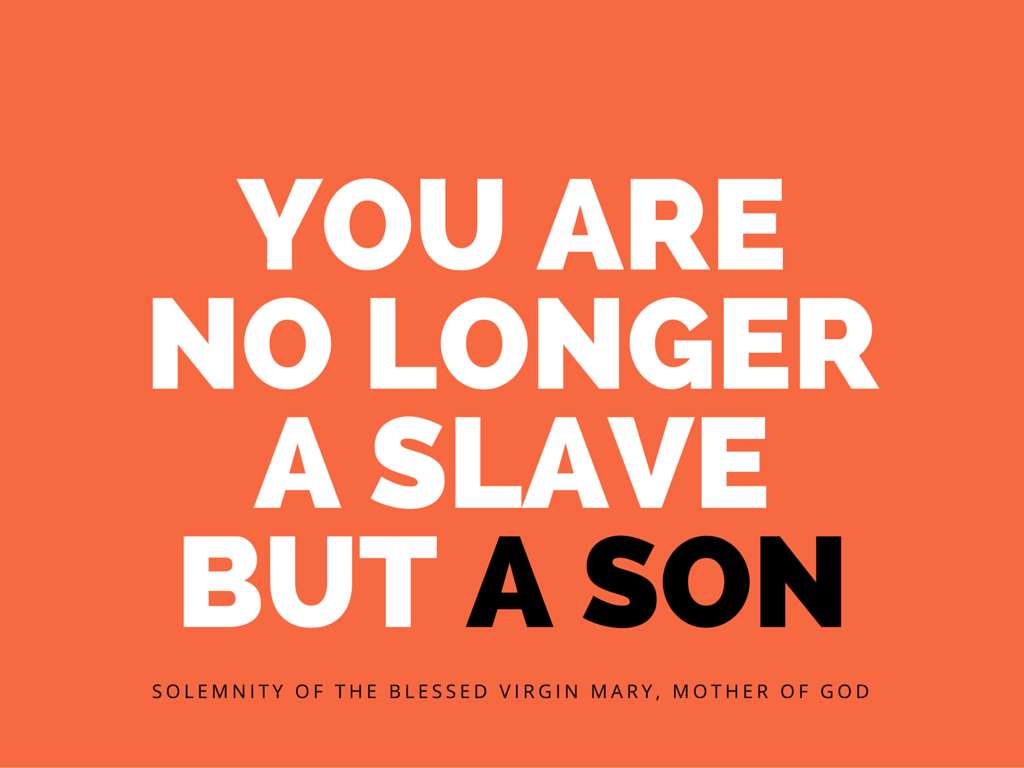
So you are no longer a slave but a son,
and if a son then also an heir, through God.
Our second reading highlights Mary’s unique role in salvation history, connecting it to the mystery of Christ’s incarnation and our adoption as children of God.
Brothers and sisters: When the fullness of time had come,
God’s plan for salvation was fulfilled at the perfect moment in history. The Incarnation was neither random nor premature but aligned with God’s redemptive timeline.
God sent his Son, born of a woman,
Jesus was not merely born but was sent, an indication of his preexistence and his eternal relationship with the Father.
Notice how Paul refers to Jesus both as God’s Son, pointing to his divine nature, and as having been born of a woman, indicating his human nature.
In one short phrase, Paul encapsulates an essential part of today’s feast.
born under the law,
Jesus entered the human condition subject to the Mosaic Law, identifying with those under the law’s demands. His life fulfilled the law perfectly, making Him the only one capable of redeeming those bound by it.
to ransom those under the law,
The concept of ransom (or in other translations, “redemption”) comes from the institution of slavery. In both the Jewish and Greco-Roman worlds, one could purchase freedom for a slave by paying a redemption price to his owners. The price of our redemption was paid with the blood of Christ (see 1 Peter 1:17-19).
Jesus, who was truly God, became human for our sake. He consented to a state of subjection and took the form of a servant, to save us from the intolerable burden of the law. This includes not only Jewish law but also moral law, against which all humans sin.
so that we might receive adoption.
By Christ’s redemption, believers are no longer slaves to sin or the law but are made children of God, sharing in his inheritance.
As proof that you are children, God sent the Spirit of his Son into our hearts, crying out, “Abba, Father!”
The sending of the Holy Spirit confirms believers’ status as God’s children (“as proof…”). This indwelling of the Spirit enables believers to address God in a deeply personal and intimate way, using “Abba” (an Aramaic term akin to “Daddy” or “Papa”).
Notice the Trinitarian action in salvation: The Father sends both the Son and the Spirit, who works in believers to unite them to Christ.
So you are no longer a slave but a son, and if a son then also an heir, through God.
Paul now contrasts the believer’s previous state of bondage under sin and the law with their new identity in Christ.
Adoption into God’s family brings freedom, dignity, and belonging. Believers are given the status of children, not servants, in God’s household.
As children of God, believers are also heirs of God’s promises and eternal inheritance. This heirship is not earned but granted through God’s grace, made possible by Christ.
Gospel – Luke 2:16-21
The shepherds went in haste to Bethlehem and found Mary and Joseph,
and the infant lying in the manger.
When they saw this,
they made known the message
that had been told them about this child.
All who heard it were amazed
by what had been told them by the shepherds.
And Mary kept all these things,
reflecting on them in her heart.
Then the shepherds returned,
glorifying and praising God
for all they had heard and seen,
just as it had been told to them.
When eight days were completed for his circumcision,
he was named Jesus, the name given him by the angel
before he was conceived in the womb.
Today’s gospel reading is essentially the same as that of the Christmas Mass at Dawn. However, this passage includes the circumcision and naming of Jesus, shifting the focus away from the shepherds to the child and his parents, especially Mary.
The shepherds went in haste and found Mary and Joseph,
The idea that shepherds would leave their flocks in the hills in search of a newborn baby was extraordinary. If anything were to happen to the sheep in their absence, the shepherds would face a significant financial loss — a risky decision, especially considering they were likely poor.
However, they were responding to heavenly revelation, as described by Luke immediately before our reading begins:
Now there were shepherds in that region living in the fields and keeping the night watch over their flock. The angel of the Lord appeared to them and the glory of the Lord shone around them, and they were struck with great fear. The angel said to them, “Do not be afraid; for behold, I proclaim to you good news of great joy that will be for all the people. For today in the city of David a savior has been born for you who is Christ and Lord. And this will be a sign for you: you will find an infant wrapped in swaddling clothes and lying in a manger.” And suddenly there was a multitude of the heavenly host with the angel, praising God and saying: “Glory to God in the highest and on earth peace to those on whom his favor rests.” (Luke 2:8-14)
This revelation wasn’t bestowed on the privileged leaders of Israel but on poor, dirty shepherds.
Note that “they went in haste.” They are full of joy and eager to see the Savior — in fact, they are the first to respond to a divine invitation to seek out this child.
and the infant lying in the manger.
This was the sign the angel had given them, that they would find an infant wrapped in swaddling clothes and lying in a manger, which was surely a unique sight. After all, who puts a baby in a feeding trough?
One would expect the infant Messiah to be draped with royal robes, lying in the warmth and security of a palace, with a long line of attendants and visitors.
When they saw this, they made known the message that had been told them about this child.
When the shepherds saw the Holy Family in the exact state the angel had predicted, they were convinced that everything the angel had told them was true: the long-awaited Messiah had arrived.
It’s reasonable to guess that the shepherds not only told Joseph and Mary about the message from the angel, but also about the entire vision of the host of angels and their song of praise. This would have been a great encouragement to them.
It is also likely that Joseph and Mary told the shepherds about the visions and experiences they’d had concerning the child. Such an exchange would have greatly strengthened the faith of both parties.
All who heard it were amazed by what had been told them by the shepherds.
They proclaimed this news to everyone they met. This was another risky move on the part of the shepherds – not only had they abandoned their flocks, now they were making truly incredible claims.
And Mary kept all these things, reflecting on them in her heart.
Mary has already experienced the wondrous power of God, having conceived and birthed a child without having relations with a man. She made clear in her Magnificat (Luke 1:46-55) that she is a believer. Now she stands silently before the mystery of what God has done, treasuring these events in her heart with respectful contemplation.
Commentators since ancient times have concluded that this line is also Luke’s way of citing the Blessed Virgin as his firsthand source. This makes sense given that Luke was a scrupulous historian and Mary was the only person who could have given an eyewitness account of the unusual events surrounding Christ’s birth.
Then the shepherds returned, glorifying and praising God for all they had heard and seen, just as it had been told to them.
The shepherds resume their lives, but they would never be the same.
When eight days were completed for his circumcision,
Circumcision was performed on Israelite males on the eighth day after birth as a sign of the covenant between God and Abraham’s descendants (Genesis 17:9-14, Leviticus 12:3).
As observant Jews, Mary and Joseph fulfilled all the prescriptions of the law.
Jesus’ circumcision underscores his complete identification with humanity and his submission to the Law of Moses (Galatians 4:4). Even as the Son of God, he fulfills the obligations of the Law, prefiguring his later statement, “I have not come to abolish the Law but to fulfill it” (Matthew 5:17).
he was named Jesus, the name given him by the angel before he was conceived in the womb.
Circumcision was often accompanied by naming the child in a combined and deeply meaningful rite.
The name Jesus (Hebrew: Yeshua) means “Yahweh saves” or “The Lord is salvation.” The angel Gabriel’s announcement in Luke 1:31 explicitly commanded this name, signifying Jesus’ mission to save his people from their sins (Matthew 1:21).
Connections and Themes
Mary. Today, we hear the familiar gospel passage about the shepherds’ visit to the manger with a focus on Mary, who is described as holding all these wondrous events in her heart, pondering their significance. She inspires us to also contemplate what has transpired within this Christmas season. Taking time to reflect on the truths of our faith, rather than mindlessly going through the motions, makes those truths real in our life experiences.
Mary’s fidelity is also evident in her obedience to God’s commands: she names the child as instructed by the angel and presents him for circumcision according to the law. Her example reminds us that fidelity to our faith disciplines the soul and sharpens our focus on God’s presence in our lives. Through reflection and obedience, we open our hearts more fully to the peace and joy brought by Christ, whose name and mission are the heart of this solemn celebration.
Blessings and prayers for peace in the New Year. The ancient prayer for shalom, the Hebrew word for peace, feels especially meaningful as we begin a new year. When God blesses us with peace, our hearts are calm and our souls can truly rest.
In today’s readings, peace is a recurring theme. The first reading overflows with blessings that call for God’s peace in our lives. The second reading reminds us that peace is our inheritance in Christ—as God’s adopted children, we have the privilege of calling Him Abba, our loving Father. In the Gospel, Mary exemplifies a profound inner peace as she reflects on everything that has happened to her and her family. Despite being far from home and having just given birth in a humble stable, she rests in the quiet confidence that God’s plan is unfolding perfectly.
The beginning of a new year is a good time to reach out and share God’s peace with others, as well as to pray for God’s blessing of shalom for all the earth. By embracing our identity as children of God, we gain a freedom of heart that empowers us to act with peace and justice.
Let us carry that freedom into the year ahead, trusting in God’s blessings to guide us.

 Sunday Readings