Psalm 72: 1-2, 7-8, 12-13, 17
Our responsorial this week comes from Psalm 72, a royal psalm praying that the king may rule with God’s justice, defend the poor, and bring peace and prosperity to the land.
This vision of a righteous ruler echoes Isaiah’s prophecy of the Spirit-anointed shoot from the stump of Jesse — a king who judges with wisdom and equity.
O God, with your judgment endow the king, and with your justice, the king’s son;
The psalm opens as a prayer for divine wisdom and righteousness for Israel’s king. Since he rules on God’s behalf, the king depends on God’s own justice to govern rightly.
By mentioning the crown prince, the psalm invokes continuity of this just rule from generation to generation — a prayer not merely for one monarch, but for a lasting dynasty grounded in God’s law.
he shall govern your people with justice and your afflicted ones with judgment.
The people are explicitly identified as belonging to God, underscoring that the king’s authority is one of stewardship, not ownership. True kingship, therefore, mirrors God’s own care for his covenant people (i.e. marked by justice and righteousness). The measure of this rule is found in how the poor and afflicted are treated.
Over time, this depiction of an ideal king and reign came to be understood in Jewish tradition as a description of the Messiah.
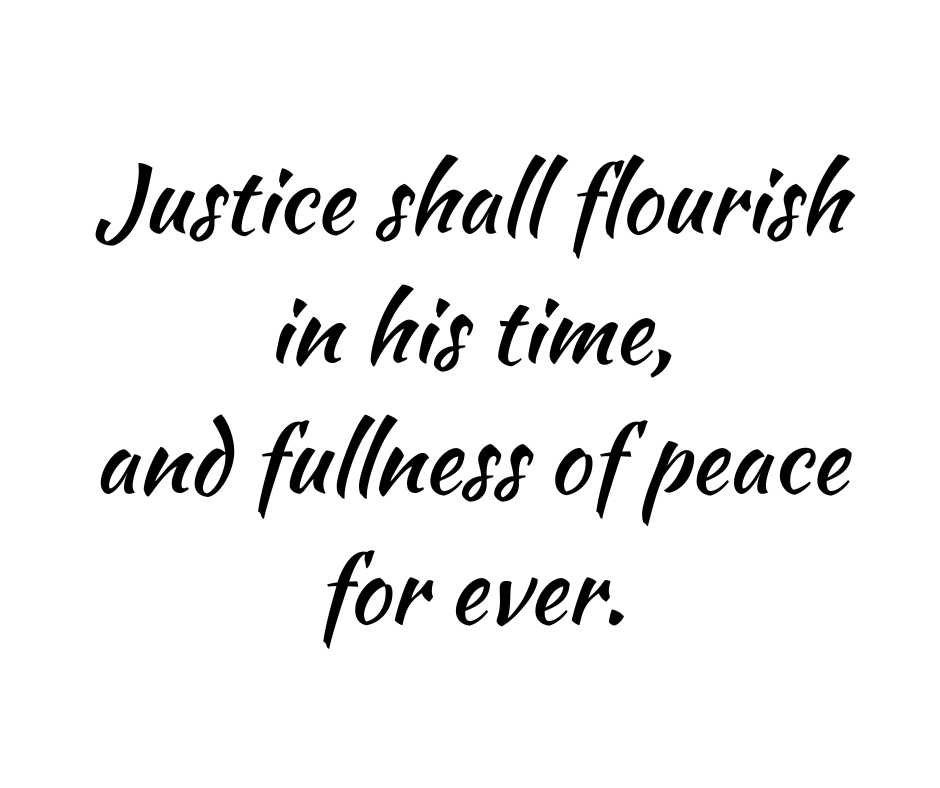
Justice shall flower in his days, and profound peace, till the moon be no more.
The psalmist envisions a reign of enduring righteousness and peace — a harmony that reflects God’s own order. The prayer is not for political power but for the flourishing of divine justice, extending beyond any earthly reign and pointing toward the everlasting peace fulfilled in Christ.
The psalmist prays that divine justice and peace will flourish so abundantly that they will endure beyond the king’s lifetime (“till the moon be no more”).
May he rule from sea to sea, and from the River to the ends of the earth.
Here the psalm widens its scope from Israel to the whole world. “The River” likely refers to the Euphrates, a symbolic eastern boundary of imperial power, while “the ends of the earth” gestures toward distant, perhaps even mythical, western lands.
What began as a prayer for a single king is now a vision of universal dominion — a reign of justice and mercy that reaches every nation.
For Christians, this points to the universal kingship of Jesus Christ, whose kingdom knows no boundaries.
For he shall rescue the poor when he cries out, and the afflicted when he has no one to help him. He shall have pity for the lowly and the poor; the lives of the poor he shall save.
The prayer continues with a picture of righteousness in action. The kingdom is rooted in the righteousness of God, and the most vulnerable in society have an advocate in the king.
May his name be blessed forever; as long as the sun his name shall remain. In him shall all the tribes of the earth be blessed; all the nations shall proclaim his happiness.
The prayer concludes in doxology — a blessing that celebrates the king’s enduring and universal legacy.
In biblical thought, one’s name signifies one’s very identity. The more important the person, the more powerful the name. From this, it is easy to understand the plea that the name of this king, and therefore his power and influence, remain blessed forever.

 Sunday Readings