Psalm 23:1-6
This week’s responsorial psalm comes from Psalm 23, one of the most well-known and beloved of all the psalms. It vividly depicts a life of peace, rest, and abundance.
God’s loving care is illustrated through the imagery of a shepherd and a host, drawing on the traditions of the Exodus (Isaiah 40:11, 49:10; Jeremiah 31:10).
The psalm’s meaning is fully realized in Jesus’ declaration, “I am the good shepherd” (John 10:11,14, Hebrews 13:20). With Christ, who has already set the table of the Eucharist for us, we look forward to the green pastures of his Kingdom, where we will find complete happiness (cf. 1 Peter 5:4, Revelation 7:17).
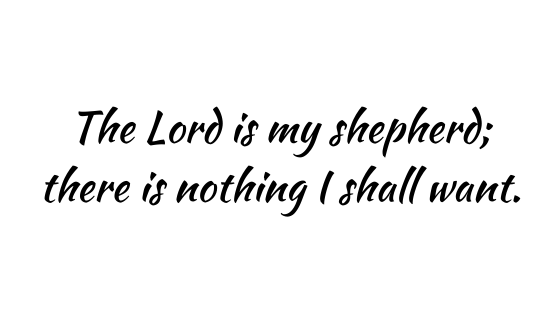
The LORD is my shepherd;
The psalm begins with a metaphor that shapes the entire song.
Portraying God as a shepherd implies guidance, provision, and protection. In the ancient Near East, kings often referred to themselves as shepherds of their people, but here, God is depicted as the true shepherd.
I shall not want.
All needs — physical, emotional, and spiritual — are met by God.
In verdant pastures he gives me repose; beside restful waters he leads me;
The verdant pastures and restful waters symbolize abundance and peace. Sheep lie down only when they are free from fear, tension, and hunger.
One of the things that makes this psalm special is its personal dimension. Rather than describe the care given to an entire flock, it describes God’s concern for one individual. God’s providence is a very intimate matter.
he refreshes my soul.
Not only are the needs of the psalmist satisfied, but the soul, the very life force of the person (nepesh) is renewed.
He guides me in right paths for his name’s sake.
The shepherd provides moral guidance as well, to honor the LORD’s name.
God’s actions reflect his character of righteousness and faithfulness.
Even though I walk in the dark valley
“Dark valley” (gey tsalmavet) is often translated as “the valley of the shadow of death.” This can refer to extreme danger, deep despair, or literal death.
I fear no evil; for you are at my side with your rod and your staff that give me courage.
The assurance of God’s presence dispels all fear.
The rod and staff symbolize God’s protection and guidance: the rod wards off predators, while the staff helps guide and rescue sheep.
Notice how the psalmist has transitioned from speaking about God to addressing God directly. The song has progressed from a general affirmation of faith to a personal expression of trust in God’s presence during the darkest times.
You spread the table before me in the sight of my foes;
Another metaphor is introduced: God is a generous host, one who prepares a lavish banquet and within whose house the psalmist ultimately dwells.
The shepherd imagery focused on the psalmist’s journey and the challenges encountered along the way; the host imagery shifts to a scene of celebration, rest, and enjoyment.
Many societies have a very strict code of hospitality. They are obliged to provide the very best provisions they have, even for their enemies. The LORD does just that here, which not only affords nourishment but also is a public witness to God’s high regard for the psalmist.
you anoint my head with oil;
In biblical tradition, anointing with oil is associated with kingship, priesthood, and healing. It signifies being set apart for a special purpose and being endowed with God’s favor.
A perfumed ointment made from olive oil was used for this purpose, especially at banquets (Psalm 104:15; Matthew 26:7; Luke 7:37; John 12:2).
my cup overflows.
The overflowing cup is a powerful symbol of God’s generosity. God’s provision is not just sufficient, it is abundant.
Only goodness and kindness follow me all the days of my life;
The magnanimous care and generosity shown by God are not motivated by fleeting emotions but by enduring covenant kindness (hesed). This love is reliable and unchanging.
and I shall dwell in the house of the LORD for years to come.
“The house of the LORD” may refer to the Temple or the broader concept of God’s dwelling place. Regardless, the fundamental meaning is clear: The psalmist has been under the loving guidance of the LORD and will remain there forever.
“Just as when a shepherd, who sees his flock scattered, takes up one of his sheep and brings it to where he wants to go, and draws the others along the path behind him, the Word of God assumed our human nature that had long gone astray. He took the form of a slave, uniting himself to all mankind, and thus led all to turn to him; in so doing, he led into the divine pastures those who had walked by dangerous ways at the mercy of rapacious wolves” (Theodoret of Cyrrhus, De Incarnatione Domini, 28).

 Sunday Readings